Data last verified: May 2026
EPF Withdrawal Rules 2026: Complete Guide for Employees
Complete guide to EPF withdrawal rules in India. Learn about partial withdrawal, full settlement, advance claims, tax implications, and online withdrawal process.
Ranveer Patel is a finance professional and founder of AbacusHand. She specialises in EMI & loan planning, income tax under old and new regimes, and SIP investment analysis for Indian households. Every calculator and article on AbacusHand is personally reviewed by her for accuracy.
Employee Provident Fund (EPF) is the largest retirement savings vehicle for salaried Indians, with over 6 crore active members. While EPF is designed for retirement, EPFO allows withdrawals under specific circumstances — medical emergencies, home purchase, education, marriage, and more. Understanding the withdrawal rules helps you access your money when needed without unnecessary penalties or tax implications. Here's the complete guide to EPF withdrawal rules updated for 2026.
Important Disclaimer
- This article is for educational and informational purposes only and does NOT constitute financial, investment, or tax advice.
- Returns and rates mentioned are indicative/historical and NOT guaranteed.
- Readers should consult a SEBI-registered investment advisor or certified financial planner before making investment decisions.
- The author is not a SEBI-registered advisor. Past performance does not guarantee future results.
Types of EPF Withdrawal
EPF withdrawals fall into three main categories: partial withdrawal (advance), full and final settlement, and pension withdrawal (EPS). Each has different rules, eligibility criteria, and tax implications. Partial withdrawals allow you to access a portion of your EPF balance for specific purposes without closing your account, while full settlement is done when you retire or remain unemployed for 2+ months. Calculate your projected EPF retirement corpus using our EPF calculator. Use our retirement calculator to estimate the corpus you need to retire comfortably.
Three types of EPF withdrawal:
- Partial Withdrawal (Advance): Withdraw a portion for specific needs (medical, housing, education) while continuing employment
- Full & Final Settlement: Complete withdrawal of EPF + EPS balance after retirement (58 years) or 2 months of unemployment
- Pension Withdrawal (EPS): Monthly pension from Employee Pension Scheme after 10 years of service and age 58
Partial Withdrawal Rules — When You Can Withdraw
EPFO allows partial withdrawals (advances) for specific life events. Each purpose has different eligibility criteria regarding years of service, withdrawal limits, and documentation requirements. Here are the detailed rules for each type of partial withdrawal allowed under EPF.
EPF partial withdrawal rules by purpose:
- Medical Treatment: No service requirement | Up to 6 months' basic salary OR employee share + interest (whichever is less) | For self, spouse, children, or parents
- Home Purchase/Construction: 5 years of service | Up to 36 months' basic salary (24 months for plot) | Only once during service | Must be in member's or spouse's name
- Home Loan Repayment: 10 years of service | Up to 36 months' basic salary | To repay outstanding home loan
- Home Renovation/Repair: 5 years of service | Up to 12 months' basic salary | Allowed twice (after 5 and 10 years)
- Marriage: 7 years of service | Up to 50% of employee share | For self, son/daughter, or sibling
- Education: 7 years of service | Up to 50% of employee share | For self or children's higher education (post-10th)
- Pre-retirement (1 year before retirement): 54 years of age | Up to 90% of total EPF balance | No specific purpose needed
- Disability/Incapacitation: No service requirement | Up to 6 months' basic salary | Medical certificate required
COVID-19 special withdrawal provision (non-refundable advance of 75% of EPF balance or 3 months' wages, whichever is lower) was a temporary measure. As of 2026, standard withdrawal rules apply. Always check the EPFO portal for the latest circulars.
Full and Final Settlement Rules
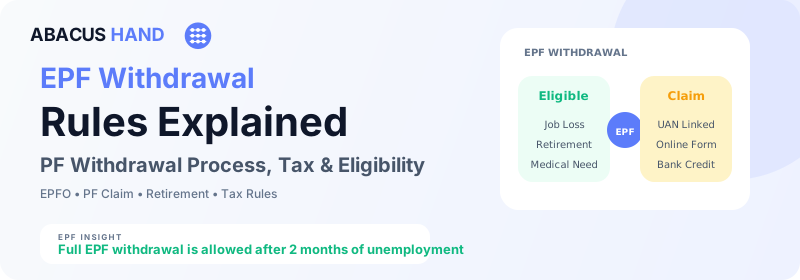
Full EPF withdrawal (final settlement) is allowed when you permanently leave employment. This includes retirement at 58, early retirement, or remaining unemployed for more than 2 months. You can withdraw 100% of your EPF balance (employee share + employer share + interest). If you're below 58 and have been unemployed for less than 2 months, you can withdraw only 75% — the remaining 25% can be withdrawn after completing 2 months of unemployment.
Full settlement eligibility:
- Retirement at 58: Full withdrawal of entire EPF balance (tax-free if 5+ years of continuous service)
- Unemployment for 2+ months: 100% withdrawal allowed (submit Form 19 + Form 10C)
- Unemployment for 1-2 months: 75% advance withdrawal allowed (remaining 25% after 2 months)
- Leaving India permanently: Full withdrawal allowed regardless of service period
- Female member leaving for marriage: Full withdrawal allowed (if not joining new employment)
- Transfer to new employer: Not a withdrawal — EPF transfers to new UAN (recommended over withdrawal)
Online EPF Withdrawal Process
EPFO has made the withdrawal process largely online through the Unified Member Portal. You can submit claims digitally without involving your employer (if your KYC is complete and Aadhaar is linked). The process typically takes 10-20 days for online claims. Here's the step-by-step process to withdraw EPF online.
Steps to withdraw EPF online:
- Step 1: Login to EPFO Member Portal (unifiedportal-mem.epfindia.gov.in) using UAN and password
- Step 2: Ensure KYC is complete — Aadhaar, PAN, and bank account must be linked and verified
- Step 3: Go to 'Online Services' → 'Claim (Form-31, 19, 10C & 10D)'
- Step 4: Verify bank account (last 4 digits shown) and enter Aadhaar-linked mobile number for OTP
- Step 5: Select claim type — PF Advance (Form 31) for partial, or Full Settlement (Form 19) for complete withdrawal
- Step 6: Choose purpose of withdrawal, enter amount, and upload required documents
- Step 7: Submit claim — OTP verification on Aadhaar-linked mobile
- Step 8: Track claim status under 'Track Claim Status' — typically processed in 10-20 days
- Amount credited directly to linked bank account via NEFT/RTGS
Tax on EPF Withdrawal
EPF withdrawal tax rules depend on your years of continuous service. If you've completed 5 years of continuous service (including transfers between employers), your EPF withdrawal is completely tax-free. If you withdraw before 5 years, the employer's contribution and interest earned become taxable. Understanding these rules helps you plan withdrawals to minimize tax impact.
EPF withdrawal tax rules:
- 5+ years of service: Entire withdrawal is TAX-FREE (no TDS, no income tax)
- Less than 5 years: Employer's contribution + interest on both shares = taxable at slab rate
- TDS on early withdrawal: 10% TDS if PAN is provided, 20% if PAN is not provided (for amounts > ₹50,000)
- No TDS if: Withdrawal is less than ₹50,000 OR service is 5+ years OR Form 15G/15H is submitted
- Transfer between employers: Not considered withdrawal — no tax implications, service continuity maintained
- Exception: If terminated due to ill health, employer closure, or reasons beyond control — tax-free even before 5 years
- Section 80C reversal: Tax deductions claimed on EPF contributions in previous years may be reversed if withdrawn before 5 years
Always transfer your EPF when changing jobs instead of withdrawing. Withdrawal before 5 years triggers tax liability AND you lose the compounding benefit. A ₹5 lakh EPF balance at 8.25% grows to ₹22 lakh in 20 years if left untouched.
Common Reasons for EPF Advance Claims
While EPF should ideally be preserved for retirement, life events sometimes require accessing these funds. The most common reasons for EPF advance claims are medical emergencies, home purchase, and education expenses. EPFO data shows that housing-related withdrawals account for the largest share of advance claims, followed by medical and education purposes.
Most common EPF advance claims (by frequency):
- Home purchase/construction: 35% of all advance claims (largest category)
- Medical treatment: 25% of claims (no service requirement makes it accessible)
- Home loan repayment: 15% of claims (reduces EMI burden significantly)
- Education: 10% of claims (children's higher education funding)
- Marriage: 8% of claims (self or children's marriage expenses)
- Pre-retirement (age 54+): 7% of claims (90% withdrawal for retirement preparation)
New EPF Rules 2026 — Key Updates
EPFO has introduced several changes in recent years to make the system more efficient and member-friendly. Here are the key updates effective in 2026 that every EPF member should know about.
Important EPF updates for 2026:
- Auto-transfer: EPF now auto-transfers when you join a new employer with the same UAN (no manual transfer needed in most cases)
- Higher pension option: Members who opted for higher EPS pension (on actual salary vs ₹15,000 cap) — deadline for application has passed
- Interest rate: EPF interest rate for FY 2025-26 is 8.25% (declared by EPFO)
- Aadhaar-based withdrawal: Claims processed in 3-5 days when Aadhaar is seeded and verified
- Auto-claim settlement: Claims under ₹50,000 with complete KYC processed within 3 working days
- EDLI benefit: Enhanced death insurance cover of up to ₹7 lakh for EPF members
- Wage ceiling: EPF contribution mandatory for employees earning up to ₹15,000/month basic (voluntary for higher salary)
Tips to Maximize Your EPF Benefits
Smart EPF strategies:
- Never withdraw when changing jobs — always transfer (preserves compounding + tax-free status)
- Increase VPF contribution: Same 8.25% guaranteed return, tax-free, with no upper limit
- Keep UAN active: Ensure Aadhaar, PAN, and bank details are updated for hassle-free claims
- Nominate family members: Update nomination on EPFO portal (important for death claims)
- Check balance regularly: Use UMANG app, missed call (011-22901406), or SMS to check balance
- Avoid partial withdrawals unless absolutely necessary — each withdrawal reduces retirement corpus significantly
- If you must withdraw, time it after 5 years of service to avoid tax
- Consider EPF as your debt/fixed-income retirement allocation (8.25% guaranteed is excellent)
Calculate how much your EPF will grow by retirement and plan your withdrawals wisely
Use EPF CalculatorFrequently Asked Questions
Yes, you can make partial withdrawals (advances) while employed for specific purposes — medical treatment, home purchase/construction, home loan repayment, education, marriage, and home renovation. Each has different service requirements (0-10 years) and withdrawal limits. You cannot do a full withdrawal while employed.
Online EPF claims with complete KYC (Aadhaar verified) typically take 10-20 days. Auto-settlement claims under ₹50,000 can be processed in 3-5 working days. Offline claims through employer may take 30-45 days. Ensure your Aadhaar, PAN, and bank account are linked and verified for fastest processing.
EPF withdrawal is tax-free if you've completed 5 years of continuous service (including transfers). If withdrawn before 5 years, the employer's contribution and interest become taxable at your income tax slab rate. TDS of 10% is deducted on taxable withdrawals above ₹50,000 (20% if PAN is not linked).
Yes, 100% withdrawal is allowed after retirement (age 58), after 2 months of continuous unemployment, when leaving India permanently, or for female members leaving employment for marriage. If unemployed for less than 2 months, you can withdraw 75% initially and the remaining 25% after completing 2 months.
No, always transfer your EPF to the new employer instead of withdrawing. Withdrawal breaks compounding (₹5 lakh at 8.25% becomes ₹22 lakh in 20 years), may trigger tax liability if service is less than 5 years, and reduces your retirement corpus. Transfer maintains continuity of service and tax-free status.