Data last verified: May 2026
NPS vs PPF: Best Retirement Savings Plan Compared
Compare NPS and PPF for retirement planning. Detailed analysis of returns, tax benefits, lock-in, withdrawal rules, and which suits your retirement goals.
Ranveer Patel is a finance professional and founder of AbacusHand. She specialises in EMI & loan planning, income tax under old and new regimes, and SIP investment analysis for Indian households. Every calculator and article on AbacusHand is personally reviewed by her for accuracy.
Planning for retirement is one of the most important financial decisions you'll make, and two of India's most popular retirement-focused instruments are NPS (National Pension System) and PPF (Public Provident Fund). Both offer excellent tax benefits, but they differ significantly in investment approach, returns potential, withdrawal flexibility, and tax treatment at maturity. This comprehensive comparison will help you decide which one — or what combination — works best for your retirement planning.
What is NPS (National Pension System)?
NPS is a government-sponsored pension scheme regulated by PFRDA (Pension Fund Regulatory and Development Authority). It's a market-linked retirement savings scheme where your money is invested in a mix of equity, corporate bonds, and government securities based on your chosen allocation. NPS offers one of the highest tax deductions available — up to ₹2 lakh per year (₹1.5 lakh under 80C + additional ₹50,000 under 80CCD(1B)). You can check how your investments grow over time using our compound interest calculator.
Key features of NPS:
- Minimum contribution: ₹500/month or ₹6,000/year (Tier I)
- Investment options: Equity (up to 75%), Corporate Bonds, Government Securities
- Tax benefit: Up to ₹2 lakh deduction (₹1.5L under 80C + ₹50K under 80CCD(1B))
- Lock-in: Till age 60 (partial withdrawal allowed after 3 years for specific purposes)
- At maturity: 60% can be withdrawn tax-free, 40% must buy annuity
- Historical returns: 9-12% depending on equity allocation
- Expense ratio: Extremely low (0.01% fund management + 0.09% CRA charges)
What is PPF (Public Provident Fund)?
PPF is a government-backed savings scheme with guaranteed returns and complete tax exemption. It has a 15-year lock-in period (extendable in 5-year blocks) and offers the safety of sovereign guarantee. PPF interest rate is set by the government quarterly — currently at 7.1% per annum for FY 2025-26. Project your PPF interest earnings and maturity value using our PPF calculator.
Key features of PPF:
- Investment limit: ₹500 to ₹1.5 lakh per year
- Interest rate: 7.1% p.a. (compounded annually, revised quarterly)
- Lock-in: 15 years (partial withdrawal after 7th year)
- Tax benefit: EEE status — investment (80C), interest, and maturity all tax-free
- Risk: Zero — Government of India sovereign guarantee
- Extension: Can extend in 5-year blocks after maturity
- Loan facility: Available from 3rd to 6th year
Returns Comparison
NPS has the potential to deliver significantly higher returns than PPF due to its equity component. Over the last 10 years, NPS Tier I equity schemes have delivered 10-14% CAGR, while PPF has given 7.1-8.7% (rate has varied over the years). However, NPS returns are not guaranteed and depend on market performance.
Investment of ₹1.5 lakh/year for 25 years:
- PPF at 7.1%: Maturity value ≈ ₹1.03 crore (guaranteed, tax-free)
- NPS at 10% (moderate equity): Expected value ≈ ₹1.48 crore
- NPS at 12% (aggressive equity): Expected value ≈ ₹1.87 crore
- Difference: NPS could give ₹45-84 lakh more, but with market risk
- PPF advantage: Entire amount is tax-free at maturity
- NPS consideration: 40% must be used to buy annuity (taxable pension income)
Tax Benefits Comparison
NPS offers a unique additional tax benefit that PPF doesn't — the extra ₹50,000 deduction under Section 80CCD(1B) over and above the ₹1.5 lakh 80C limit. This means NPS investors in the 30% tax bracket save an additional ₹15,600 in taxes every year. However, PPF wins at maturity — the entire PPF corpus is tax-free, while NPS has partial taxation.
Tax treatment at maturity:
- PPF: 100% tax-free (EEE status) — investment, interest, and withdrawal all exempt
- NPS (at 60): 60% lump sum withdrawal is tax-free (changed in Budget 2019)
- NPS: 40% must be used to buy annuity — annuity income is taxable at slab rate
- NPS (before 60): Only 20% can be withdrawn as lump sum (tax-free), 80% must buy annuity
- Annual tax saving with NPS: Up to ₹62,400 (₹2 lakh × 31.2% including cess)
- Annual tax saving with PPF: Up to ₹46,800 (₹1.5 lakh × 31.2% including cess)
The extra ₹50,000 NPS deduction under 80CCD(1B) is available even if you've exhausted your ₹1.5 lakh 80C limit with PPF, ELSS, or EPF. Many smart investors use both PPF and NPS to maximize tax savings up to ₹2 lakh.
Withdrawal and Liquidity
PPF allows partial withdrawal from the 7th financial year — up to 50% of the balance at the end of the 4th year or the preceding year, whichever is lower. NPS is more restrictive — partial withdrawal (up to 25% of own contributions) is allowed only after 3 years for specific reasons like children's education, home purchase, or medical treatment, limited to 3 times during the entire tenure.
Investment Flexibility
NPS investment choices:
- Active Choice: You decide allocation between Equity (E), Corporate Bonds (C), and Government Securities (G)
- Auto Choice (Lifecycle Fund): Allocation automatically adjusts based on age — more equity when young, more debt near retirement
- Aggressive LC50: Starts with 75% equity at age 35, reduces to 15% by age 55
- Moderate LC25: Starts with 50% equity, reduces to 10% by age 55
- Conservative LC75: Starts with 25% equity, reduces to 5% by age 55
- Maximum equity allowed: 75% till age 50, then reduces by 2.5% each year
Who Should Choose NPS?
NPS is ideal for:
- Salaried individuals who've exhausted 80C limit and want additional ₹50,000 tax benefit
- Investors comfortable with market-linked returns for higher growth
- Those who want a disciplined, locked retirement corpus (can't withdraw easily)
- People in the 30% tax bracket (maximum tax saving benefit)
- Young investors (25-35) who can allocate 75% to equity for long-term growth
- Government employees (mandatory NPS with employer contribution)
Who Should Choose PPF?
PPF is ideal for:
- Conservative investors who want guaranteed, risk-free returns
- Self-employed individuals (PPF is one of the best retirement options for them)
- Those who want complete tax-free returns at maturity (EEE benefit)
- Investors who prefer not to deal with market volatility
- People who want partial withdrawal flexibility after 7 years
- Those building the debt/fixed-income portion of their retirement portfolio
The Optimal Strategy: Use Both
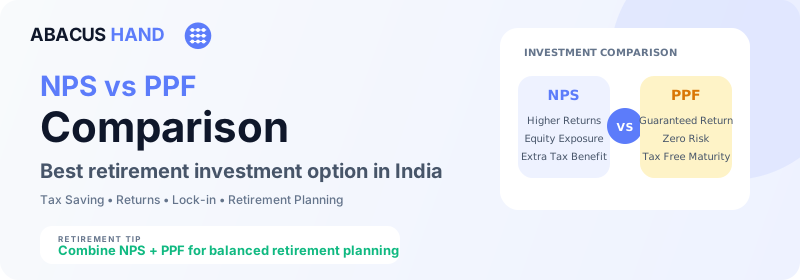
The smartest approach for most investors is to use both NPS and PPF. Invest ₹50,000 in NPS to claim the additional 80CCD(1B) deduction, and invest in PPF for guaranteed tax-free returns. If you're in the 30% bracket, the NPS ₹50,000 saves you ₹15,600 in taxes annually. Combined with PPF's guaranteed 7.1% tax-free returns, you get the best of both worlds — tax efficiency, safety, and growth potential.
If you're a salaried employee with EPF, your employer's EPF contribution already provides debt-like retirement savings. In this case, allocate NPS aggressively to equity (75%) for maximum growth, and use PPF as your guaranteed-return component.
Calculate your PPF maturity value and plan your retirement corpus
Use PPF CalculatorFrequently Asked Questions
NPS offers higher return potential (10-12%) with market risk, while PPF gives guaranteed 7.1% tax-free returns. For most people, using both is optimal — NPS for growth and extra tax benefit, PPF for guaranteed safety. Young investors with 25+ years to retirement benefit more from NPS's equity exposure.
Yes, and it's recommended. You can claim ₹1.5 lakh under 80C (PPF/ELSS/EPF) plus additional ₹50,000 under 80CCD(1B) for NPS — total ₹2 lakh tax deduction. This saves up to ₹62,400 in taxes annually for those in the 30% bracket.
At 60, you can withdraw 60% of your NPS corpus as a tax-free lump sum. The remaining 40% must be used to purchase an annuity plan from an empaneled insurance company, which provides you a monthly pension (taxable at your slab rate).
NPS is regulated by PFRDA and managed by professional fund managers (SBI, LIC, HDFC, etc.). While short-term fluctuations are possible in the equity portion, long-term NPS returns have been consistently positive. The government securities (G) portion carries zero credit risk. You're unlikely to lose money over a 20+ year horizon.