Data last verified: May 2026
How Much Money Do You Need to Retire in India?
Calculate exactly how much corpus you need to retire comfortably in India. Understand the 25x rule, inflation impact, and realistic retirement numbers for different lifestyles.
Ranveer Patel is a finance professional and founder of AbacusHand. She specialises in EMI & loan planning, income tax under old and new regimes, and SIP investment analysis for Indian households. Every calculator and article on AbacusHand is personally reviewed by her for accuracy.
The most common question in retirement planning is: 'How much is enough?' The answer depends on your lifestyle expectations, location, healthcare needs, and how long you expect to live in retirement. Most Indians drastically underestimate their retirement corpus requirement because they forget to account for inflation, healthcare costs, and the sheer length of retirement (potentially 25-30 years). Let's calculate your exact number using proven frameworks and realistic Indian financial data.
Important Disclaimer
- This article is for educational and informational purposes only and does NOT constitute financial, investment, or tax advice.
- Returns and rates mentioned are indicative/historical and NOT guaranteed.
- Readers should consult a SEBI-registered investment advisor or certified financial planner before making investment decisions.
- The author is not a SEBI-registered advisor. Past performance does not guarantee future results.
The 25x Rule Explained
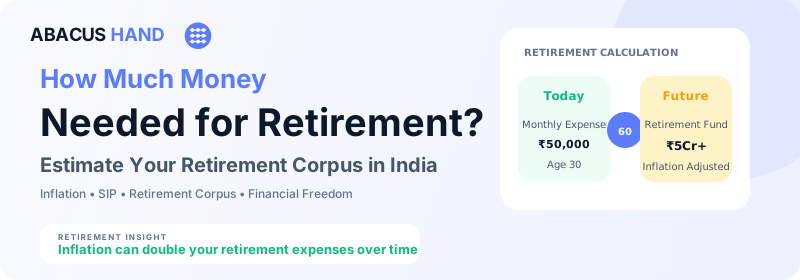
The 25x rule (derived from the 4% safe withdrawal rate) states that your retirement corpus should be 25 times your annual expenses. This means if you withdraw 4% of your corpus each year, adjusted for inflation, your money should last 30+ years. For example, if your annual expenses are ₹6 lakh (₹50,000/month), you need ₹6 lakh × 25 = ₹1.5 crore. But this is in today's rupees — you must adjust for inflation to get the actual target. Use our retirement calculator to estimate the corpus you need to retire comfortably. Check the future purchasing power of your savings using our inflation calculator.
25x rule calculation steps:
- Step 1: Calculate current monthly expenses (include everything — rent, food, utilities, entertainment, insurance)
- Step 2: Multiply by 12 to get annual expenses
- Step 3: Adjust for inflation till retirement (use 6% for India)
- Step 4: Multiply inflation-adjusted annual expenses by 25
- Example: ₹50,000/month today → ₹6L/year → ₹19.3L/year after 20 years at 6% inflation → Corpus needed: ₹4.83 crore
- For Indian conditions, consider using 30x-33x multiplier for extra safety margin
The 4% rule was developed based on US market data. For India, where inflation is higher (6% vs 2-3% in US) and retirement could be longer, a 3-3.5% withdrawal rate (meaning 28x-33x multiplier) is more conservative and safer.
Inflation Impact on Your Retirement Corpus
Inflation is the single biggest factor most people ignore in retirement planning. At 6% average inflation (India's long-term average), the purchasing power of money halves every 12 years. What costs ₹1 lakh today will cost ₹3.2 lakh in 20 years. Healthcare inflation is even worse at 12-15% annually. If you're 30 today and plan to retire at 55, your expenses will be 4.3x higher at retirement than they are now.
How inflation multiplies your retirement needs (at 6% inflation):
- 10 years from now: ₹50,000/month becomes ₹89,500/month
- 15 years from now: ₹50,000/month becomes ₹1,20,000/month
- 20 years from now: ₹50,000/month becomes ₹1,60,000/month
- 25 years from now: ₹50,000/month becomes ₹2,15,000/month
- 30 years from now: ₹50,000/month becomes ₹2,87,000/month
- Healthcare costs (at 12% inflation): ₹5 lakh surgery today = ₹48 lakh in 20 years
Lifestyle-Based Retirement Corpus Estimates
Let's calculate realistic retirement corpus requirements for three different lifestyle levels in India. We'll assume retirement at age 55, current age 30, 6% general inflation, 12% healthcare inflation, and a 30-year retirement period. These numbers include regular living expenses, healthcare costs, travel, and a buffer for unexpected expenses.
Basic Lifestyle — ₹30,000/Month (Today's Value)
Retirement corpus for basic lifestyle:
- Current monthly expenses: ₹30,000 (₹3.6 lakh/year)
- Expenses at retirement (25 years, 6% inflation): ₹1,29,000/month (₹15.5 lakh/year)
- Corpus needed (25x): ₹3.87 crore
- Corpus needed (30x — safer): ₹4.65 crore
- Monthly SIP needed (starting now, 12% returns, 25 years): ₹24,500
- Suitable for: Tier-2/3 city living, modest lifestyle, own house (no rent)
Comfortable Lifestyle — ₹50,000/Month (Today's Value)
Retirement corpus for comfortable lifestyle:
- Current monthly expenses: ₹50,000 (₹6 lakh/year)
- Expenses at retirement (25 years, 6% inflation): ₹2,15,000/month (₹25.8 lakh/year)
- Corpus needed (25x): ₹6.45 crore
- Corpus needed (30x — safer): ₹7.74 crore
- Monthly SIP needed (starting now, 12% returns, 25 years): ₹40,800
- Suitable for: Metro city living, annual vacations, good healthcare, comfortable lifestyle
Premium Lifestyle — ₹1,00,000/Month (Today's Value)
Retirement corpus for premium lifestyle:
- Current monthly expenses: ₹1,00,000 (₹12 lakh/year)
- Expenses at retirement (25 years, 6% inflation): ₹4,29,000/month (₹51.5 lakh/year)
- Corpus needed (25x): ₹12.9 crore
- Corpus needed (30x — safer): ₹15.5 crore
- Monthly SIP needed (starting now, 12% returns, 25 years): ₹81,600
- Suitable for: Premium metro living, international travel, best healthcare, luxury lifestyle
Healthcare Costs in Retirement
Healthcare is the wildcard in retirement planning. Medical inflation in India runs at 12-15% annually — double the general inflation rate. A bypass surgery costing ₹4 lakh today could cost ₹40+ lakh in 20 years. After age 60, healthcare expenses typically account for 20-30% of total retirement spending. You need both comprehensive health insurance AND a dedicated medical corpus to handle this.
Planning for healthcare costs in retirement:
- Health insurance: ₹25-50 lakh base cover + ₹50 lakh-1 crore super top-up
- Dedicated medical corpus: ₹25-50 lakh in liquid/short-term debt funds
- Annual health insurance premium at 60+: ₹40,000-80,000 (factor this into expenses)
- Critical illness cover: Consider separate ₹25-50 lakh critical illness policy before 45
- Don't rely on employer insurance — it ends at retirement
- Budget for dental, vision, and preventive care (not covered by most policies)
Where to Invest for Your Retirement Corpus
Building a multi-crore retirement corpus requires a mix of growth and safety instruments. Equity mutual funds (especially index funds and flexi-cap funds) should form the core of your retirement portfolio during the accumulation phase. As you approach retirement, gradually shift to debt instruments for stability. Here's a practical investment plan for building your retirement corpus.
Recommended retirement investment vehicles:
- Equity Mutual Funds (Nifty 50/Next 50 index funds): Core growth engine, 12-14% long-term CAGR
- EPF/VPF: Guaranteed 8.25% tax-free, employer matching (maximize this first)
- PPF: ₹1.5 lakh/year at 7.1% guaranteed, completely tax-free (EEE)
- NPS: Additional ₹50,000 tax benefit, market-linked returns (9-12%)
- ELSS Mutual Funds: Tax saving under 80C + equity growth potential
- Gold (Sovereign Gold Bonds): 2.5% interest + gold price appreciation, hedge against inflation
- REITs: Real estate exposure without buying property, 6-8% dividend yield
Common Mistakes in Estimating Retirement Corpus
Avoid these calculation errors:
- Using today's expenses without inflation adjustment (biggest mistake — underestimates by 3-5x)
- Ignoring healthcare inflation (12-15% vs 6% general inflation)
- Assuming retirement lasts only 15-20 years (plan for 30 years — you might live to 85+)
- Not accounting for lifestyle inflation (expenses tend to increase, not decrease in early retirement)
- Counting primary residence as retirement corpus (you can't eat your house)
- Overestimating pension/rental income and underestimating expenses
- Forgetting about taxes on retirement income (FD interest, NPS annuity are taxable)
- Not building a buffer for unexpected expenses (home repairs, family emergencies)
Calculate your exact retirement corpus requirement based on your age, expenses, and goals
Use Retirement CalculatorFrequently Asked Questions
To retire at 50 with ₹50,000/month expenses (today's value), you need approximately ₹5.2-6.5 crore (accounting for 6% inflation over 20 years and using 25x-30x multiplier). You'll also need comprehensive health insurance and a separate medical emergency fund of ₹25-50 lakh.
₹5 crore can support a comfortable retirement if you retire today with monthly expenses of ₹1.5-1.7 lakh (using 4% withdrawal rate). However, if you're retiring 15-20 years from now, ₹5 crore may only support ₹50,000-60,000/month in today's purchasing power due to inflation. Your actual needs depend on lifestyle, location, and healthcare requirements.
The 4% rule states that you can withdraw 4% of your retirement corpus in the first year, then adjust for inflation each subsequent year, and your money should last 30+ years. For a ₹5 crore corpus, this means withdrawing ₹20 lakh in year one (₹1.67 lakh/month), increasing by inflation each year.
At 6% inflation, prices double every 12 years. Monthly expenses of ₹50,000 today become ₹1.6 lakh in 20 years and ₹3.2 lakh in 32 years. Healthcare inflation is even higher at 12-15%. This means your retirement corpus needs to be 3-5x larger than what you'd calculate using today's expenses.
No, don't count your primary residence as part of your retirement corpus unless you plan to sell it and downsize. You need a place to live, so your house doesn't generate income or cover expenses. Only count investments that can generate regular income — mutual funds, FDs, rental properties (other than your home), pension, etc.