Data last verified: May 2026
SWP vs SIP: Understanding the Key Differences
Compare SWP and SIP in mutual funds. Learn when to use Systematic Withdrawal Plan vs Systematic Investment Plan, tax implications, and which suits your goals.
Ranveer Patel is a finance professional and founder of AbacusHand. She specialises in EMI & loan planning, income tax under old and new regimes, and SIP investment analysis for Indian households. Every calculator and article on AbacusHand is personally reviewed by her for accuracy.
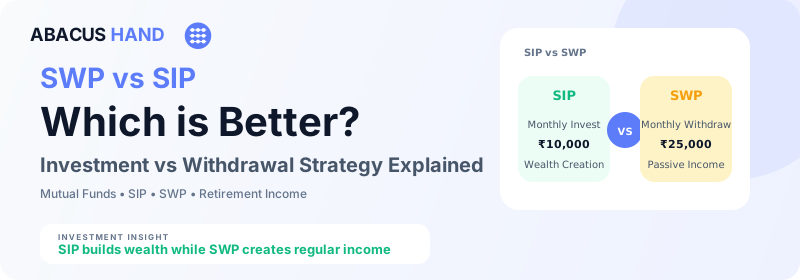
SIP and SWP are two sides of the same coin in mutual fund investing. SIP (Systematic Investment Plan) helps you build wealth by investing regularly, while SWP (Systematic Withdrawal Plan) helps you generate regular income by withdrawing systematically from your accumulated corpus. Understanding when and how to use each — and how they work together as a lifecycle strategy — is essential for effective financial planning. This guide breaks down both strategies with practical examples for Indian investors.
Important Disclaimer
- This article is for educational and informational purposes only and does NOT constitute financial, investment, or tax advice.
- Returns and rates mentioned are indicative/historical and NOT guaranteed.
- Readers should consult a SEBI-registered investment advisor or certified financial planner before making investment decisions.
- The author is not a SEBI-registered advisor. Past performance does not guarantee future results.
What is SIP (Systematic Investment Plan)?
SIP is a method of investing a fixed amount in mutual funds at regular intervals — typically monthly. It's designed for the wealth accumulation phase of your financial life. When you set up a ₹10,000/month SIP, your bank automatically debits this amount and purchases mutual fund units at the current NAV. Over time, you benefit from rupee cost averaging (buying more units when markets are low, fewer when high) and the power of compounding. You can estimate your investment growth using our free SIP calculator.
Key features of SIP:
- Purpose: Wealth accumulation — building corpus over time
- How it works: Fixed amount invested at regular intervals (monthly/weekly/daily)
- Minimum amount: As low as ₹100-500/month depending on the fund
- Benefit: Rupee cost averaging reduces impact of market volatility
- Best for: Salaried individuals investing from monthly income
- Duration: Typically 5-30 years (longer = better compounding)
- NAV impact: You buy units at different NAVs, averaging your cost
What is SWP (Systematic Withdrawal Plan)?
SWP is the reverse of SIP — instead of investing regularly, you withdraw a fixed amount from your mutual fund investment at regular intervals. It's designed for the income generation phase, typically during retirement. If you have a ₹1 crore corpus in a mutual fund, you can set up an SWP of ₹50,000/month. The fund house redeems units worth ₹50,000 each month and credits the amount to your bank account, while the remaining corpus continues to grow. Plan your monthly retirement cash flows using our SWP calculator.
Key features of SWP:
- Purpose: Regular income generation from existing corpus
- How it works: Fixed amount withdrawn at regular intervals from mutual fund
- Minimum corpus: Varies by fund (typically ₹25,000-1 lakh minimum balance)
- Benefit: Tax-efficient regular income (only gains portion is taxed, not principal)
- Best for: Retirees, those needing regular income from investments
- Duration: Can continue as long as corpus lasts
- NAV impact: Units are redeemed at current NAV — fewer units sold when NAV is high
Key Differences Between SIP and SWP
SIP vs SWP comparison:
- Direction: SIP = money flows IN to mutual fund | SWP = money flows OUT from mutual fund
- Purpose: SIP = wealth creation | SWP = income generation
- Life stage: SIP = earning/accumulation years (25-55) | SWP = retirement/distribution years (55+)
- Units: SIP = units are purchased | SWP = units are redeemed
- NAV benefit: SIP = buy more units when NAV is low | SWP = sell fewer units when NAV is high
- Tax: SIP = no tax on investment | SWP = tax only on capital gains portion of each withdrawal
- Corpus effect: SIP = corpus grows over time | SWP = corpus depletes (but can grow if returns > withdrawal rate)
- Flexibility: Both allow changing amount, pausing, or stopping anytime
- Minimum: SIP = ₹100-500/month | SWP = depends on fund (₹500-1000/withdrawal typical)
When to Use SIP
SIP is your primary wealth-building tool during your earning years. It works best when you have regular income and a long investment horizon. The beauty of SIP is that it removes the need to time the market — you invest consistently regardless of market conditions, and rupee cost averaging ensures you get a reasonable average purchase price over time.
Ideal scenarios for SIP:
- Building retirement corpus over 15-30 years
- Saving for children's education (10-18 year horizon)
- Creating wealth from monthly salary (automate and forget)
- Goal-based investing: house down payment, wedding, car
- When you don't have a large lump sum but have regular income
- New investors who want to start small and increase gradually
When to Use SWP
SWP becomes relevant when you've accumulated a corpus and need regular income from it. It's particularly powerful for retirees because it's more tax-efficient than alternatives like FD interest or dividend plans. With SWP, only the capital gains portion of each withdrawal is taxed — not the entire amount. This can save significant taxes compared to earning interest income.
Ideal scenarios for SWP:
- Generating monthly pension-like income during retirement
- Creating regular income from a lump sum (inheritance, property sale proceeds)
- Supplementing pension/salary with additional monthly income
- Tax-efficient alternative to FD interest (especially for those in 20-30% bracket)
- Funding regular expenses like EMIs, insurance premiums, or child's education fees
- When you want your corpus to continue growing while providing income
Tax Comparison: SIP vs SWP
Understanding the tax treatment of SIP and SWP is crucial for maximizing post-tax returns. SIP investments themselves don't attract any tax — you're taxed only when you eventually redeem. SWP withdrawals are partially taxable, but the tax treatment is highly favorable compared to alternatives like FD interest.
Tax treatment comparison:
- SIP (Equity funds, held >1 year): LTCG at 10% on gains above ₹1 lakh/year
- SIP (Equity funds, held <1 year): STCG at 15%
- SIP (Debt funds): Gains taxed at income tax slab rate (no LTCG benefit since 2023)
- SWP (Equity funds): Each withdrawal — only gains portion taxed (LTCG/STCG based on holding period of units redeemed)
- SWP tax advantage: If you withdraw ₹50,000 and cost basis of units is ₹45,000, only ₹5,000 gain is taxable
- FD interest comparison: Entire ₹50,000 interest is taxable at slab rate (up to 31.2%)
- SWP from equity fund (held >1 year): Effective tax rate often 1-3% vs 20-30% for FD interest
For retirees in the 20-30% tax bracket, SWP from equity mutual funds can save ₹1-3 lakh in taxes annually compared to earning the same income from FDs. The longer you've held the fund, the lower the taxable gains portion in each SWP withdrawal.
SWP for Retirement Income — A Practical Example
Let's see how SWP works as a retirement income strategy. Suppose you retire at 55 with a ₹2 crore corpus in a balanced advantage fund (expected returns: 9-10% annually). You set up an SWP of ₹80,000/month. At 9% annual returns, your corpus actually grows despite withdrawals — after 20 years, you'd have withdrawn ₹1.92 crore AND still have ₹2.5+ crore remaining. This is the magic of SWP — your money works for you while providing regular income.
SWP retirement example (₹2 crore corpus, ₹80,000/month withdrawal, 9% returns):
- Year 1: Withdrawn ₹9.6 lakh | Remaining corpus: ₹2.08 crore
- Year 5: Total withdrawn ₹48 lakh | Remaining corpus: ₹2.38 crore
- Year 10: Total withdrawn ₹96 lakh | Remaining corpus: ₹2.85 crore
- Year 15: Total withdrawn ₹1.44 crore | Remaining corpus: ₹3.42 crore
- Year 20: Total withdrawn ₹1.92 crore | Remaining corpus: ₹4.08 crore
- Key insight: At 9% returns with 4.8% withdrawal rate, corpus grows indefinitely
Combining SIP and SWP — The Lifecycle Strategy
The most effective approach is using SIP and SWP as complementary strategies across your financial lifecycle. During your earning years (25-55), use SIP to build your corpus aggressively in equity funds. As you approach retirement (50-55), gradually shift some corpus to balanced or debt funds. Post-retirement, set up SWP from these funds for regular income while keeping a portion in equity for long-term growth.
Lifecycle strategy combining SIP and SWP:
- Age 25-45: Aggressive SIP in equity funds (₹15,000-50,000/month, increase 10% yearly)
- Age 45-50: Continue SIP but start shifting 20-30% corpus to balanced/hybrid funds
- Age 50-55: Reduce equity SIP, increase debt fund SIP, build 2-3 year expense buffer
- Age 55 (retirement): Stop SIP, set up SWP from balanced/debt funds for monthly income
- Post-55: Keep 30-40% in equity funds (no SWP from these — let them grow for later years)
- Review annually: Adjust SWP amount for inflation (increase by 5-6% each year)
Calculate how much monthly income your corpus can generate through SWP
Use SWP CalculatorFrequently Asked Questions
SIP (Systematic Investment Plan) is for investing money regularly into mutual funds to build wealth. SWP (Systematic Withdrawal Plan) is for withdrawing money regularly from your mutual fund corpus to generate income. SIP is used during earning years, SWP during retirement or when you need regular income from investments.
Yes, SWP is generally more tax-efficient than FD interest for those in the 20-30% tax bracket. With SWP from equity funds (held >1 year), only the gains portion is taxed at 10% LTCG, while FD interest is fully taxable at your slab rate. SWP can also provide inflation-beating returns if the fund performs well.
Yes, you can have SIP in one fund and SWP from another simultaneously. This is common during the transition to retirement — you might continue SIP in equity funds for long-term growth while running SWP from debt/balanced funds for current income needs.
For a sustainable ₹50,000/month SWP (₹6 lakh/year), you need approximately ₹1.2-1.5 crore invested in a balanced or equity fund earning 8-10% annually. At this withdrawal rate (4-5%), your corpus can last 25-30+ years. Using the 25x rule: ₹6 lakh × 25 = ₹1.5 crore.