Data last verified: May 2026
Lump Sum vs SIP: When to Choose Which Strategy
Compare lump sum and SIP investment strategies. Learn when each works best, with real data on returns, risk management, and practical decision framework.
Ranveer Patel is a finance professional and founder of AbacusHand. She specialises in EMI & loan planning, income tax under old and new regimes, and SIP investment analysis for Indian households. Every calculator and article on AbacusHand is personally reviewed by her for accuracy.
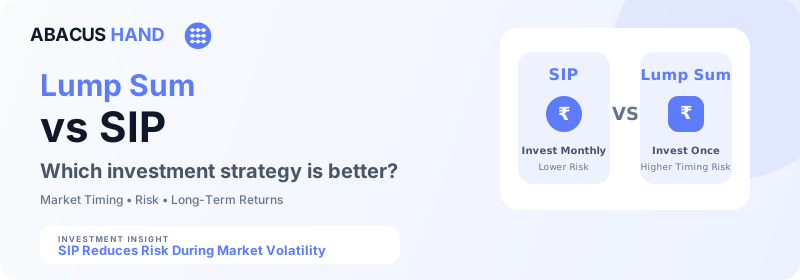
Should you invest a large amount all at once (lump sum) or spread it over time through SIP? This is one of the most debated questions in personal finance. The academic answer is clear — lump sum wins about 65-70% of the time because markets trend upward. But the practical answer depends on your psychology, market conditions, and the source of your money. Let's break down both strategies with real Indian market data.
What is Lump Sum Investing?
Lump sum investing means putting your entire available amount into the market at once. If you receive a ₹5 lakh bonus, you invest all ₹5 lakh immediately in mutual funds or stocks. The advantage is that your entire capital starts working for you from day one, maximizing the time in the market. The risk is that if markets fall immediately after your investment, your entire capital takes the hit. Try our mutual fund return calculator to estimate your potential returns.
What is SIP (Systematic Investment Plan)?
SIP means investing a fixed amount at regular intervals (usually monthly). If you have ₹5 lakh, you could invest ₹50,000/month over 10 months instead of all at once. SIP provides rupee cost averaging — you buy more units when markets are low and fewer when high, resulting in a lower average cost per unit. This reduces the impact of market timing on your returns. You can estimate your investment growth using our free SIP calculator.
Historical Data: Lump Sum vs SIP Returns
Analysis of Nifty 50 data from 2000 to 2025 shows that lump sum investing outperformed SIP in approximately 65-70% of rolling 5-year periods. This makes sense because equity markets have an upward bias — they spend more time going up than going down. However, in the 30-35% of periods where SIP won, it was often during or just before major market crashes (2008, 2020).
Real examples from Indian markets:
- Jan 2008 (pre-crash): ₹10L lump sum → ₹7.8L by Dec 2008 (-22%). SIP of ₹83K/month → ₹8.9L (-11%)
- Jan 2015 (stable market): ₹10L lump sum → ₹14.2L by Dec 2017 (+42%). SIP → ₹13.1L (+31%)
- Jan 2020 (pre-COVID): ₹10L lump sum → ₹15.8L by Dec 2022 (+58%). SIP → ₹14.5L (+45%)
- Mar 2020 (post-crash): ₹10L lump sum → ₹21L by Mar 2023 (+110%). SIP → ₹16.2L (+62%)
- Key insight: Lump sum at market bottoms gives extraordinary returns, but timing bottoms is nearly impossible
When Lump Sum is Better
Choose lump sum when:
- Markets have recently crashed 20-30% (buying at a discount)
- You have a long investment horizon (10+ years) — short-term timing matters less
- Market valuations are reasonable (Nifty PE below 20-22)
- You receive a one-time amount (inheritance, property sale, bonus) and don't need it for 7+ years
- You're investing in debt funds (low volatility, lump sum almost always wins)
- You have strong emotional discipline and won't panic-sell during corrections
When SIP is Better
Choose SIP when:
- Markets are at all-time highs or seem overvalued (Nifty PE above 24-25)
- You're investing from monthly salary (natural SIP from income)
- You're a new investor who might panic during market falls
- You're unsure about market direction and want to reduce timing risk
- You're investing a large amount relative to your net worth (can't afford a 30% drawdown)
- Market volatility is high (VIX above 20) — SIP smooths out the bumps
The best approach for most people: If you have a lump sum AND regular income, invest the lump sum based on market conditions (or use STP), and set up a separate SIP from your monthly salary. This gives you the best of both worlds.
The STP Strategy: Best of Both Worlds
STP (Systematic Transfer Plan) is a hybrid approach. You invest your lump sum in a liquid or ultra-short-term debt fund, then set up automatic weekly or monthly transfers to an equity fund. For example, invest ₹10 lakh in a liquid fund (earning 6-7% while parked), then transfer ₹1 lakh/month to an equity fund over 10 months. This way, your money earns returns while waiting, and you get the averaging benefit of SIP.
STP example with ₹10 lakh:
- Park ₹10 lakh in liquid fund (earns ~6.5% annually while waiting)
- Set up monthly STP of ₹1 lakh to equity fund for 10 months
- Or weekly STP of ₹25,000 for 40 weeks (better averaging)
- Money in liquid fund earns ~₹5,400/month while waiting to be transferred
- Total extra earnings from liquid fund during STP period: ₹25,000-30,000
- You get rupee cost averaging + returns on idle money
Market Valuation Guide for Decision Making
One practical framework uses the Nifty 50 PE ratio to decide between lump sum and SIP. The PE ratio tells you how 'expensive' the market is relative to earnings. Historical average Nifty PE is around 20-22. When PE is below average, lump sum tends to work better. When PE is above average, SIP or STP is safer.
Decision framework based on Nifty PE:
- Nifty PE below 18 (market crash/undervalued): Invest 100% lump sum immediately
- Nifty PE 18-20 (fairly valued): Invest 50% lump sum + STP remaining 50% over 6 months
- Nifty PE 20-24 (slightly overvalued): Use STP over 6-12 months
- Nifty PE above 24 (expensive): Use STP over 12-18 months or stick to monthly SIP
- Check current Nifty PE at: NSE India website or Trendlyne
Psychological Factor: Why SIP Wins for Most People
While data favors lump sum, human psychology often makes SIP the better practical choice. Studies show that investors who invest lump sum at market peaks often panic-sell during subsequent corrections, locking in losses. SIP investors, having bought at various levels, see smaller drawdowns and are less likely to panic. The best investment strategy is the one you can stick with — and for most people, that's SIP.
Lump Sum in Debt Funds: Almost Always Better
For debt mutual funds (liquid, short-term, corporate bond funds), lump sum is almost always better than SIP. Debt funds have very low volatility (daily NAV changes of 0.01-0.05%), so there's minimal benefit from rupee cost averaging. Your money starts earning from day one, and the compounding benefit of having the full amount invested immediately outweighs any averaging advantage.
Tax Implications
Tax considerations for both strategies:
- Lump sum: Single purchase date — easy to track holding period for LTCG/STCG
- SIP: Each installment has its own purchase date — FIFO method for redemption
- SIP advantage: If you redeem partially, oldest units (held longest) are sold first — more likely to qualify for LTCG
- Equity LTCG (held >1 year): 10% on gains above ₹1 lakh
- Equity STCG (held <1 year): 15% flat
- STP from liquid to equity: Each transfer is a redemption from liquid fund (may attract short-term capital gains)
Don't let tax considerations drive your investment strategy. The difference in returns between lump sum and SIP (2-5% over a few years) is usually much larger than the tax impact. Focus on the right strategy for your risk profile first.
Calculate and compare your lump sum vs SIP returns with actual numbers
Use SIP CalculatorFrequently Asked Questions
Historically, lump sum outperforms SIP about 65-70% of the time because markets trend upward. However, SIP is better during overvalued markets, for new investors who might panic-sell, and when you're investing from monthly income. The best choice depends on market conditions and your risk tolerance.
When markets are at all-time highs (Nifty PE above 24), it's generally safer to use STP (Systematic Transfer Plan) — park money in a liquid fund and transfer to equity over 6-12 months. This reduces the risk of investing everything at a peak.
STP (Systematic Transfer Plan) lets you invest a lump sum in a debt/liquid fund and automatically transfer a fixed amount to an equity fund at regular intervals. It combines the safety of SIP (averaging) with the benefit of earning returns on idle money in the liquid fund.
Yes, and many investors do. A common approach: invest lump sums (bonus, inheritance) based on market valuations, while maintaining a regular monthly SIP from salary. This maximizes both time in market and rupee cost averaging benefits.