Data last verified: May 2026
Inflation in India: How It Eats Your Savings Silently
Understand how inflation erodes your savings and purchasing power in India. Learn real inflation rates, impact on FDs and savings, and strategies to beat it.
Ranveer Patel is a finance professional and founder of AbacusHand. She specialises in EMI & loan planning, income tax under old and new regimes, and SIP investment analysis for Indian households. Every calculator and article on AbacusHand is personally reviewed by her for accuracy.
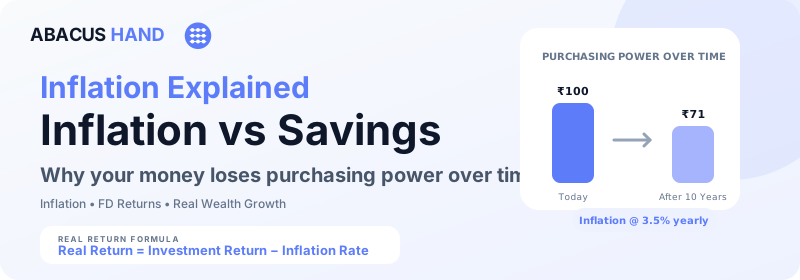
Inflation is the silent wealth destroyer that most Indians underestimate. While your savings account earns 3-4% interest and FDs give 6-7%, inflation in India has averaged 6-7% over the past decade. This means your money is barely keeping up — or worse, losing purchasing power every year. ₹1 lakh today will buy goods worth only ₹55,000 in 10 years at 6% inflation. Understanding inflation's impact is the first step to protecting your wealth.
What is Inflation and How is it Measured in India?
Inflation is the rate at which prices of goods and services increase over time, reducing the purchasing power of money. In India, inflation is primarily measured by the Consumer Price Index (CPI), tracked by the Ministry of Statistics. The Reserve Bank of India (RBI) targets CPI inflation at 4% (with a tolerance band of 2-6%). When inflation exceeds 6%, RBI typically raises interest rates to control it. Check the future purchasing power of your savings using our inflation calculator. Estimate your fixed deposit returns and maturity amount using our FD calculator.
India's inflation history (CPI annual average):
- 2019: 4.8%
- 2020: 6.2% (pandemic supply disruptions)
- 2021: 5.1%
- 2022: 6.7% (global commodity price surge)
- 2023: 5.4%
- 2025: ~5.0% (estimated)
- 10-year average: ~5.8%
- 20-year average: ~6.5%
Real Inflation vs Official Inflation
The official CPI number often feels lower than what you actually experience. This is because CPI is a weighted average across all categories. Your personal inflation rate depends on your spending pattern. Education inflation in India runs at 10-12% annually, healthcare at 8-10%, and housing in metros at 7-9%. If you're saving for your child's education or medical expenses, your effective inflation is much higher than the headline 5-6%.
Category-wise inflation rates (approximate annual averages):
- Education: 10-12% (school/college fees double every 6-7 years)
- Healthcare: 8-10% (medical costs rising faster than general inflation)
- Housing (metro cities): 7-9% (rent and property prices)
- Food & groceries: 6-8% (volatile, depends on monsoon)
- Transportation: 5-7% (fuel, vehicle costs)
- Lifestyle & entertainment: 5-6%
- Electronics & technology: -2 to 2% (prices often decrease)
When planning for goals like education or healthcare, use category-specific inflation (10-12%) rather than general CPI (5-6%). This prevents massive shortfalls in your financial planning.
How Inflation Destroys Your Savings
Let's see what happens to ₹10 lakh kept in different instruments over 10 and 20 years, assuming 6% average inflation:
₹10 lakh in savings account (3.5% interest):
- After 10 years: Grows to ₹14.1 lakh nominally
- Real value (adjusted for 6% inflation): ₹7.87 lakh
- Purchasing power LOST: ₹2.13 lakh (21.3% erosion)
- After 20 years: Nominal ₹19.9 lakh, Real value ₹6.2 lakh — lost 38% purchasing power!
₹10 lakh in FD (7% interest, pre-tax):
- After 10 years: Grows to ₹19.67 lakh nominally
- Post-tax return (30% bracket): Effective rate ~4.9%
- Real value after tax and inflation: ₹9.3 lakh
- You barely maintained purchasing power — zero real growth!
₹10 lakh in equity mutual funds (12% CAGR):
- After 10 years: Grows to ₹31.06 lakh nominally
- Post-tax (12.5% LTCG above ₹1.25L): ~₹28.5 lakh
- Real value (inflation-adjusted): ₹15.9 lakh
- Real wealth CREATED: ₹5.9 lakh (59% real growth)
The Rule of 72: When Prices Double
The Rule of 72 tells you how quickly prices double: divide 72 by the inflation rate. At 6% inflation, prices double every 12 years. This means what costs ₹1 lakh today will cost ₹2 lakh in 12 years and ₹4 lakh in 24 years. For education at 10% inflation, costs double every 7.2 years — a ₹20 lakh engineering degree today will cost ₹40 lakh in just 7 years.
Price doubling timeline at different inflation rates:
- 4% inflation: Prices double in 18 years
- 6% inflation: Prices double in 12 years
- 8% inflation: Prices double in 9 years
- 10% inflation: Prices double in 7.2 years
- 12% inflation: Prices double in 6 years
Why FDs and Savings Accounts Fail Against Inflation
Fixed deposits are India's most popular investment, but they often deliver negative real returns after accounting for both inflation and taxes. Here's why:
FD returns vs inflation (30% tax bracket):
- FD interest rate: 7.0%
- Tax on interest (30% + cess): -2.18%
- Post-tax return: 4.82%
- Inflation: -6.0%
- Real return: -1.18% (you're LOSING money in real terms!)
- Even at 7.5% FD rate, real return is only -0.75% after tax
FDs are suitable for emergency funds and short-term goals (1-3 years), but for long-term wealth building (5+ years), they guarantee purchasing power erosion. Equity is essential for beating inflation over the long term.
Investments That Beat Inflation
Inflation-beating investment options for Indians:
- Equity Mutual Funds (SIP): 12-15% historical CAGR, best for 5+ year goals
- Direct Stocks (Nifty 50): ~12% CAGR over 20 years, requires knowledge
- Real Estate: 8-10% appreciation in good locations (plus rental yield)
- Gold: 10-11% CAGR over 20 years in India (hedge against uncertainty)
- PPF: 7.1% tax-free = ~10% pre-tax equivalent (safe, guaranteed)
- NPS: 9-12% returns depending on equity allocation
- REITs: 7-9% yield + capital appreciation
Inflation-Adjusted Goal Planning
When setting financial goals, always account for inflation. Here's how common goals inflate over time:
Goal inflation examples (starting from today's cost):
- Child's engineering (₹20 lakh today, 10% education inflation): ₹52 lakh in 10 years
- Child's MBA (₹25 lakh today): ₹65 lakh in 10 years
- Retirement corpus (₹50,000/month expenses today, 6% inflation): Need ₹1.6 lakh/month in 20 years
- House purchase (₹80 lakh today, 7% appreciation): ₹1.57 crore in 10 years
- Car purchase (₹12 lakh today, 5% inflation): ₹19.5 lakh in 10 years
How to Protect Your Wealth from Inflation
Practical strategies to beat inflation:
- Invest in equity for all goals 5+ years away (SIP in index funds or diversified funds)
- Keep only 3-6 months expenses in savings account (not more)
- Limit FDs to emergency fund and goals within 1-3 years
- Increase SIP amount by 10% every year (step-up SIP) to match income growth
- Invest in PPF for guaranteed inflation-beating tax-free returns
- Consider gold (10-15% of portfolio) as an inflation hedge
- Review and rebalance portfolio annually
- Increase income through skill development — your earning power must grow faster than inflation
Inflation and Retirement Planning
Inflation is most dangerous for retirement planning because of the long time horizon. If you need ₹50,000/month today for comfortable living, you'll need approximately ₹1,60,000/month in 20 years (at 6% inflation) and ₹2,87,000/month in 30 years. Your retirement corpus must generate inflation-adjusted income for 25-30 years post-retirement. This is why financial planners recommend a corpus of 25-30x your annual expenses at retirement.
Retirement corpus needed (₹50,000/month current expenses):
- Retiring in 20 years: Need ~₹4.8 crore corpus (at 6% inflation)
- Retiring in 25 years: Need ~₹6.4 crore corpus
- Retiring in 30 years: Need ~₹8.6 crore corpus
- Monthly SIP needed for ₹5 crore in 25 years (12% return): ~₹26,000
Calculate how inflation affects your savings and goals
Use Inflation CalculatorFrequently Asked Questions
India's CPI inflation is approximately 5-5.5% (FY2025-26). However, category-specific inflation varies significantly — education inflation is 10-12%, healthcare 8-10%, and housing in metros 7-9%. Your personal inflation depends on your spending pattern.
Generally no, especially after tax. A 7% FD in the 30% tax bracket gives only 4.82% post-tax return. With 6% inflation, your real return is -1.18%. FDs are suitable for short-term parking of funds but not for long-term wealth building.
To beat inflation, your investments must earn more than 6-7% after tax. Equity mutual funds (12-15% pre-tax) and PPF (7.1% tax-free) are reliable inflation beaters. For long-term goals, allocate 60-80% to equity through SIPs for consistent inflation-beating returns.
Inflation dramatically increases the corpus needed for retirement. At 6% inflation, ₹50,000/month expenses today become ₹1.6 lakh/month in 20 years. You need a corpus of 25-30x annual expenses at retirement to sustain 25-30 years of post-retirement life with rising costs.