Data last verified: June 2026
Gratuity Calculation Rules & Formula in India
Calculate gratuity with the 15/26 formula. Understand the 5-year eligibility rule, ₹20 Lakh tax exemption, and private sector payment rules in India.
Ranveer Patel is a finance professional and founder of AbacusHand. She specialises in EMI & loan planning, income tax under old and new regimes, and SIP investment analysis for Indian households. Every calculator and article on AbacusHand is personally reviewed by her for accuracy.
Most salaried employees know that gratuity is 'something you get when you leave after 5 years,' but very few know exactly how much they'll receive, how it's taxed, or what happens if they're fired. I've seen employees be pleasantly surprised with ₹3-4 lakh they didn't expect, and I've also seen cases where companies wrongly denied gratuity to people who clearly deserved it.
Whether you're nearing a job change, planning retirement, or just want to understand your salary better — this guide covers everything about gratuity calculation in India with actual numbers. Calculate your monthly take-home pay and tax deductions using our salary calculator. Calculate your projected EPF retirement corpus using our EPF calculator.
Gratuity is governed by the Payment of Gratuity Act, 1972. Rules may differ for government employees, seasonal establishments, and certain exempt categories. This article covers the most common scenario — private sector employees covered under the Act. For specific cases, consult your HR department or a labor law expert.
What is Gratuity and Who Gets It?
Gratuity is a lump-sum payment made by your employer as a token of appreciation for your service, payable when you leave the organization. It's a statutory benefit — meaning if you qualify, your employer must pay it. It's not optional or at their discretion.
Gratuity eligibility criteria:
- You must have completed 5 continuous years of service with the same employer
- The '5 years' rule has a relaxation: 4 years and 240 days (for non-seasonal establishments) qualifies you
- Payable on: Resignation, retirement, retrenchment, disability, or death
- In case of death or disability: No minimum service period required
- Applies to: All establishments with 10 or more employees (once applicable, remains applicable even if count drops below 10)
- Covers: All employees regardless of salary level, designation, or whether you're permanent or contractual (if on rolls)
The 4 years 240 days rule is important. If you're at 4 years 8 months and thinking of switching, wait those extra few weeks — you'll qualify for gratuity that could be worth ₹2-5 lakh depending on your salary.
The Gratuity Calculation Formula
For employees covered under the Payment of Gratuity Act (most private sector), the formula is:
Gratuity = (15 × Last drawn salary × Years of service) ÷ 26
Understanding each component:
- 15: Fixed multiplier representing 15 days' wages for each year of service
- Last drawn salary: Basic salary + Dearness Allowance (DA) at the time of leaving
- Years of service: Completed years (6 months and above is rounded up to the next year)
- 26: Working days in a month (as per the Act, not calendar days)
- For employees NOT covered under the Act: Formula is (15 × salary × years) ÷ 30
Real Calculation Examples
Let me calculate gratuity for three different salary levels so you can estimate yours:
Example 1: Mid-level IT professional
- Last basic + DA: ₹50,000/month
- Years of service: 7 years 8 months (rounds up to 8 years)
- Gratuity = (15 × 50,000 × 8) ÷ 26 = ₹2,30,769
Example 2: Senior manager at a manufacturing company
- Last basic + DA: ₹1,20,000/month
- Years of service: 12 years 3 months (stays at 12 years — below 6 months doesn't round up)
- Gratuity = (15 × 1,20,000 × 12) ÷ 26 = ₹8,30,769
Example 3: Long-tenure employee nearing retirement
- Last basic + DA: ₹80,000/month
- Years of service: 25 years
- Gratuity = (15 × 80,000 × 25) ÷ 26 = ₹11,53,846
Notice how quickly gratuity adds up with longer tenure. The combination of higher last-drawn salary (due to increments) and more years creates a multiplicative effect. Someone staying 20 years at one company can easily accumulate ₹10-20 lakh in gratuity.
Tax Treatment of Gratuity
This is where most people get confused. The tax rules differ based on whether you're a government employee or private sector:
Tax exemption on gratuity:
- Government employees: Entire gratuity is TAX-FREE (no limit)
- Private sector employees covered under the Act: Exempt up to ₹20,00,000 (increased from ₹10 lakh in 2019)
- Private sector not covered under the Act: Exempt = least of (a) ₹20 lakh, (b) actual gratuity, (c) half month salary × years of service
- Any amount above the exemption limit is taxable as 'Income from Salary'
- If you receive gratuity from multiple employers in your career, the ₹20 lakh limit is CUMULATIVE (total lifetime exemption)
The lifetime cumulative cap is important. If you received ₹8 lakh exempt gratuity from your first employer and ₹15 lakh from your second, only ₹12 lakh of the second amount is exempt (₹20 lakh total limit minus ₹8 lakh already claimed). The remaining ₹3 lakh is taxable.
Pro tip: Your employer will deduct TDS on any gratuity amount exceeding ₹20 lakh before paying you. If you've already used part of the ₹20 lakh exemption with a previous employer, inform your current employer to avoid under-deduction of TDS (which creates issues during ITR filing).
Government vs Private Sector Gratuity
There are meaningful differences in how gratuity works for government employees versus private sector:
Key differences:
- Formula: Government uses (last pay × years × 15) ÷ 26; same formula but 'last pay' includes more components
- Maximum limit: Government employees have no cap on tax exemption; private sector is capped at ₹20 lakh exempt
- Government gratuity maximum: Currently capped at ₹20 lakh payment for central govt employees (revised periodically)
- Qualifying service: Government requires 5 years minimum (same as private sector)
- Government employees get gratuity even for being absorbed post-merger of departments
- Private sector employers may offer higher gratuity voluntarily beyond the statutory minimum
Can Your Employer Forfeit Your Gratuity?
This is a fear many employees have, especially those leaving on less-than-great terms. The law is clear but nuanced:
Gratuity forfeiture rules:
- Gratuity can be forfeited ONLY if termination is due to misconduct involving moral turpitude (theft, fraud, violence)
- The misconduct must have occurred during the course of employment
- Simple resignation (even during notice period), poor performance, or policy disagreements are NOT grounds for forfeiture
- Forfeiture is only to the extent of damage/loss caused by the employee to the employer
- If terminated for non-misconduct reasons (redundancy, restructuring), full gratuity is payable
- Absconding without notice: Gratuity is still payable — but the employer can deduct notice period salary from it
Recent court rulings have been very employee-friendly on this. In several High Court and Supreme Court judgments, courts have ruled that even if an employee is terminated for 'poor performance,' gratuity cannot be denied unless moral turpitude is proven. If your employer is withholding gratuity without valid cause, you can file a complaint with the Controlling Authority (usually the Labour Commissioner).
Common Situations and Your Gratuity Rights
FAQ scenarios:
- Company shut down: You're still entitled to gratuity; company must pay from available assets
- Transferred to a group company: If continuous service is maintained, previous tenure counts
- Contract employee converted to permanent: Contract period counts toward 5-year qualification if employment was continuous
- Resigned before serving full notice: Gratuity is payable; company can only deduct notice period shortfall
- Laid off due to recession: Full gratuity payable (no misconduct involved)
- Company delays payment: Must pay within 30 days of it becoming due; delay attracts simple interest
How to Verify Your Gratuity Calculation
When you receive your full and final settlement, verify the gratuity amount yourself:
Verification checklist:
- Check that 'last drawn salary' includes basic + DA (not just basic)
- Verify the years of service count — check if 6+ months has been rounded up
- Confirm the formula used is 15/26 (not 15/30 if you're covered under the Act)
- Cross-check with your gratuity nominee form (most companies require this at joining)
- If your CTC mentions gratuity as a component, note that the CTC gratuity figure is an annual provision — not your actual payout
- Actual payout is based on last drawn salary at exit, which may be much higher than the annual provision
Pro tip: The gratuity shown in your CTC is typically calculated on your joining salary. But actual gratuity at exit is based on your LAST drawn salary. After 8-10 years of increments, your actual gratuity could be 2-3x what your original CTC indicated. It's a pleasant surprise for many.
Gratuity is your earned right after 5 years of service. Know the formula, understand the tax rules, and don't let any employer wrongfully deny or delay it. If you're planning to switch jobs, a quick gratuity calculation can help you decide whether waiting a few more months to cross the 5-year (or 4 years 240 days) mark is worth the extra ₹2-5 lakh.
Calculate your exact gratuity amount based on your current salary and years of service.
Use Salary CalculatorFrequently Asked Questions
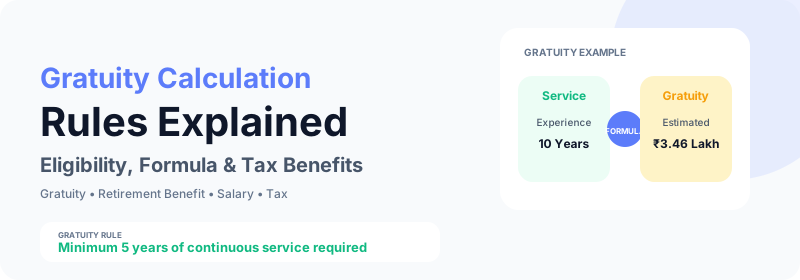
The formula is: Gratuity = (15 × Last drawn basic + DA × Years of service) ÷ 26. For example, if your last basic + DA is ₹60,000 and you've served 10 years, your gratuity = (15 × 60,000 × 10) ÷ 26 = ₹3,46,154. Service of 6 months or more in the last year is rounded up to the next full year.
For government employees, gratuity is fully tax-free. For private sector employees, gratuity up to ₹20 lakh is exempt from income tax (increased from ₹10 lakh in March 2019). This is a lifetime cumulative limit across all employers. Any amount exceeding ₹20 lakh is added to your taxable income for that year.
Yes! The Supreme Court has ruled that 4 years and 240 days of continuous service (approximately 4 years 8 months for a 6-day work week) qualifies you for gratuity. You don't need to complete exactly 5 calendar years. Count your actual working days — if you've crossed 240 days in the 5th year, you're eligible.
No, your employer cannot deny gratuity for not serving notice period. Gratuity is a statutory right after 5 years of service and can only be forfeited in cases of misconduct involving moral turpitude (theft, fraud, etc.). However, the company can deduct the notice period salary shortfall from your full and final settlement, including from gratuity.
No, usually not. The gratuity in your CTC is an annual provision based on your joining salary (typically 4.81% of basic). Your actual gratuity payout at exit is calculated on your last drawn salary, which will be much higher after years of increments. For example, if your CTC shows ₹24,000/year gratuity provision, after 8 years with salary growth, your actual payout could be ₹3-4 lakh.