Data last verified: May 2026
Loan Against Property: When and How to Use It
Complete guide to Loan Against Property (LAP) in India. Learn eligibility, interest rates, LTV ratio, documentation, and when LAP is better than a personal loan.
Ranveer Patel is a finance professional and founder of AbacusHand. She specialises in EMI & loan planning, income tax under old and new regimes, and SIP investment analysis for Indian households. Every calculator and article on AbacusHand is personally reviewed by her for accuracy.
Loan Against Property (LAP) is one of the most versatile secured loan products available in India. It allows you to unlock the value of your residential or commercial property without selling it, providing funds at interest rates significantly lower than personal loans. With LAP rates starting at 8.5-9.5% p.a. compared to 10.5-16% for personal loans, and loan amounts ranging from ₹5 lakh to ₹10 crore, LAP serves as a powerful financial tool for business expansion, education funding, medical emergencies, or debt consolidation.
What is Loan Against Property?
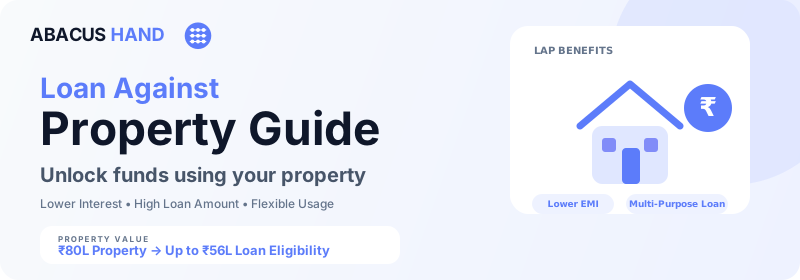
Loan Against Property (LAP) is a secured loan where you pledge your owned property — residential house, commercial space, or plot of land — as collateral to borrow money. Unlike a home loan (which finances property purchase), LAP provides funds for any purpose while you continue to use and live in the pledged property. The bank places a lien on the property title until the loan is fully repaid. You can typically borrow 50-70% of the property's current market value, with repayment tenures extending up to 15-20 years.
LAP Interest Rates: Bank-Wise Comparison (2025-26)
Current Loan Against Property interest rates from major lenders in India:
- SBI: 8.70-10.50% p.a. (lowest for salaried with 750+ CIBIL)
- HDFC Bank: 9.00-11.50% p.a. (competitive for high-value properties)
- ICICI Bank: 9.00-11.25% p.a. (quick processing for existing customers)
- Axis Bank: 9.25-11.75% p.a. (flexible tenure up to 20 years)
- Bank of Baroda: 8.85-10.75% p.a. (attractive PSU bank rates)
- Bajaj Finserv: 9.50-13.00% p.a. (higher LTV ratio up to 75%)
- Tata Capital: 9.75-12.50% p.a. (flexible for self-employed)
- PNB Housing: 9.25-12.00% p.a. (accepts wider property types)
How Much Can You Borrow? Understanding LTV Ratio
The Loan-to-Value (LTV) ratio determines how much you can borrow against your property. Most banks offer 50-70% LTV for LAP, meaning a property valued at ₹1 crore can fetch ₹50-70 lakh as loan. The LTV varies by property type: residential properties get higher LTV (60-70%), commercial properties get 50-60%, and vacant land typically gets 40-50%. The bank conducts an independent valuation through approved valuers — this assessed value (not your purchase price or expected market value) determines the loan amount.
The bank's valuation is often 10-20% lower than actual market value due to conservative assessment. If you disagree with the valuation, you can request a re-evaluation or try a different lender whose panel valuers may assess differently.
When to Use Loan Against Property
LAP is ideal in several scenarios where you need substantial funds at reasonable rates. Business expansion or working capital needs (₹10-50 lakh+) where business loan rates are too high. Higher education abroad where education loan limits are insufficient. Medical emergencies requiring ₹10-20 lakh+ where personal loan EMIs would be unaffordable. Debt consolidation — replacing multiple high-interest personal loans and credit card debt with a single low-interest LAP. Wedding expenses where the amount needed exceeds personal loan eligibility. Estimate the maximum loan amount you can qualify for using our free loan eligibility calculator.
LAP vs Personal Loan: Detailed Comparison
For a ₹20 lakh requirement, here's how LAP compares to a personal loan. Personal Loan: rate 12%, tenure 5 years, EMI ₹44,489, total interest ₹6,69,334. LAP: rate 9.5%, tenure 10 years, EMI ₹25,879, total interest ₹11,05,530. LAP with 7-year tenure: rate 9.5%, EMI ₹33,199, total interest ₹7,88,700. While LAP's total interest over 10 years is higher due to longer tenure, the monthly EMI burden is nearly half. If you choose a 7-year LAP tenure, you save ₹1.19 lakh in interest compared to the personal loan while still having a lower EMI. You can use our free EMI calculator to instantly verify these calculations.
Eligibility Criteria for Loan Against Property
General eligibility requirements for LAP across major Indian lenders:
- Age: 25-65 years (loan should be repaid before age 70 for salaried, 75 for self-employed)
- Income: Minimum ₹3-5 lakh annual income (varies by lender and city)
- CIBIL Score: 650+ (some NBFCs accept 600+ at higher rates)
- Property: Must be free from legal disputes, fully constructed, with clear title
- Property Age: Building should not be older than 30-40 years (varies by lender)
- Ownership: Property must be in applicant's name (or co-applicant's) for minimum 1-3 years
- Employment: Minimum 2-3 years work experience (salaried) or 3-5 years business vintage (self-employed)
Documents Required for LAP Application
Keep these documents ready before applying for Loan Against Property:
- Identity proof: Aadhaar, PAN card, passport
- Address proof: Utility bills, Aadhaar, passport
- Income proof: Salary slips (6 months), Form 16, IT returns (2-3 years)
- Bank statements: 6-12 months of primary salary/business account
- Property documents: Sale deed, title deed, property tax receipts, approved building plan
- Encumbrance certificate: Proving property is free from existing loans/liens
- Property valuation report: Some banks arrange this; others accept external reports
- Business proof (self-employed): GST registration, business financials, P&L statements
Processing Time and Fees
LAP processing takes 10-21 days — longer than personal loans due to property verification, legal checks, and physical valuation. Processing fees range from 0.5-1.5% of the loan amount (₹10,000-₹1.5 lakh on a ₹1 crore loan). Additional costs include property valuation fee (₹2,000-5,000), legal verification fee (₹2,000-5,000), stamp duty on mortgage deed (varies by state, typically 0.1-0.5%), and documentation charges. Factor these costs into your decision — on smaller loans (under ₹10 lakh), these fees can make LAP less attractive compared to a personal loan.
Negotiate processing fees — many banks waive or reduce them during festive seasons or for existing customers. Some banks offer zero processing fee LAP during special campaigns.
Risks and Precautions with LAP
The biggest risk with LAP is losing your property if you default. Under the SARFAESI Act, banks can auction your property after 60 days of notice if you fail to repay. Never pledge your primary residence for speculative investments or non-essential expenses. Other risks include: property value depreciation reducing your equity, floating interest rates increasing EMI burden over time, and prepayment penalties (some lenders charge 2-4% on floating rate LAP foreclosure). Always maintain an emergency fund covering 6 months of EMI before taking LAP.
Tax Benefits on Loan Against Property
Tax benefits on LAP depend on how you use the funds. If used for purchasing or constructing another residential property, you can claim interest deduction under Section 24(b) up to ₹2 lakh per year and principal repayment under Section 80C up to ₹1.5 lakh. If used for business purposes, the entire interest paid is deductible as a business expense. However, if used for personal expenses (wedding, travel, medical), no tax benefit is available on LAP. Plan your fund usage strategically to maximize tax savings.
How to Get the Best LAP Deal
Follow these tips to secure the most favorable Loan Against Property terms:
- Compare at least 3-4 lenders — rates can vary by 1-2% for the same profile
- Apply with your primary bank where you have salary account for preferential rates
- Maintain CIBIL score above 750 for the lowest rates
- Choose the shortest tenure you can afford — saves significantly on total interest
- Opt for floating rate (currently lower) but budget for potential rate increases
- Negotiate processing fees and get fee waiver commitments in writing
Calculate your LAP EMI and total interest cost for different loan amounts and tenures
Use EMI CalculatorFrequently Asked Questions
Yes, this is called a second charge LAP or top-up loan. However, the available amount is limited to the difference between the property's current value and outstanding home loan. For example, if property is worth ₹80 lakh and home loan outstanding is ₹30 lakh, you may get ₹20-25 lakh as LAP (total lending capped at 60-70% of property value).
Most lenders accept: self-occupied residential property, rented residential property, commercial property (office/shop), and industrial property. Vacant land is accepted by fewer lenders and at lower LTV (40-50%). The property must have clear title, no legal disputes, approved building plan, and should not be too old (typically under 30-40 years).
You cannot sell the property without the lender's consent since they hold a lien on the title. To sell, you must first close the LAP (either through prepayment or from sale proceeds). Some banks allow property sale if the buyer agrees to pay the outstanding loan amount directly to the bank from the sale consideration.
For amounts above ₹10-15 lakh, LAP is usually better due to lower interest rates (9-11% vs 14-18% for unsecured business loans) and longer tenure (up to 15-20 years vs 5-7 years). However, business loans have faster processing (3-7 days vs 15-21 days for LAP) and don't risk your property. Choose based on amount needed, urgency, and risk tolerance.