Data last verified: May 2026
Power of Compounding: How ₹1,000/Month Becomes ₹1 Crore
Understand the power of compounding with real examples. See how small monthly investments of ₹1,000 can grow to ₹1 crore through disciplined investing.
Ranveer Patel is a finance professional and founder of AbacusHand. She specialises in EMI & loan planning, income tax under old and new regimes, and SIP investment analysis for Indian households. Every calculator and article on AbacusHand is personally reviewed by her for accuracy.
Albert Einstein reportedly called compound interest the 'eighth wonder of the world.' Whether or not he actually said it, the math behind compounding is truly remarkable. A simple ₹1,000 monthly investment, started early enough, can grow to over ₹1 crore. This isn't magic — it's the mathematical certainty of compounding working over time. Let's break down exactly how this works and how you can harness it.
What is Compounding?
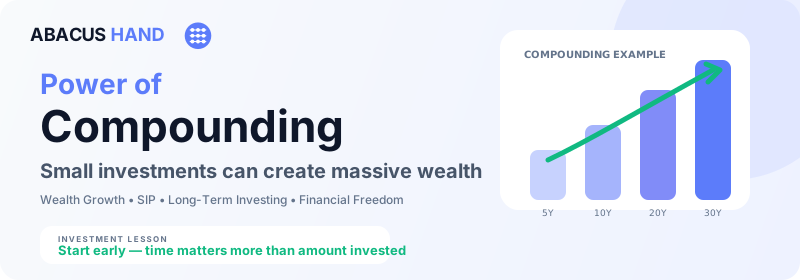
Compounding is the process where your investment earns returns, and those returns themselves earn further returns. It's essentially 'interest on interest.' In simple interest, ₹1 lakh at 10% gives you ₹10,000 every year — always on the original amount. With compound interest, the first year gives ₹10,000, but the second year calculates 10% on ₹1,10,000 (giving ₹11,000), the third year on ₹1,21,000, and so on. The growth becomes exponential over time. You can check how your investments grow over time using our compound interest calculator.
The ₹1,000/Month to ₹1 Crore Journey
Here's the exact math: If you invest ₹1,000 per month in an equity mutual fund via SIP earning an average 12% annual return (which is close to Nifty 50's historical average), your investment grows as follows over different time periods. You can estimate your investment growth using our free SIP calculator.
Growth of ₹1,000/month SIP at 12% annual returns:
- After 10 years: Invested ₹1.2 lakh → Value ₹2.32 lakh (profit: ₹1.12 lakh)
- After 15 years: Invested ₹1.8 lakh → Value ₹5.01 lakh (profit: ₹3.21 lakh)
- After 20 years: Invested ₹2.4 lakh → Value ₹9.99 lakh (profit: ₹7.59 lakh)
- After 25 years: Invested ₹3 lakh → Value ₹18.97 lakh (profit: ₹15.97 lakh)
- After 30 years: Invested ₹3.6 lakh → Value ₹35.29 lakh (profit: ₹31.69 lakh)
- After 35 years: Invested ₹4.2 lakh → Value ₹64.97 lakh (profit: ₹60.77 lakh)
- After 38 years: Invested ₹4.56 lakh → Value ₹1.01 crore (profit: ₹96.44 lakh)
At 12% returns, ₹1,000/month takes about 38 years to reach ₹1 crore. At 15% returns (achievable with good mid-cap funds), it takes only 32 years. Starting at age 25 means you hit ₹1 crore by age 57-63.
Why Time Matters More Than Amount
The most powerful factor in compounding isn't the rate of return or even the amount invested — it's time. Consider two investors: Priya starts investing ₹5,000/month at age 25 and stops at 35 (10 years, total invested: ₹6 lakh). Rahul starts investing ₹5,000/month at age 35 and continues until 60 (25 years, total invested: ₹15 lakh). At 12% returns, Priya's corpus at age 60 would be ₹1.54 crore, while Rahul's would be ₹94.9 lakh. Priya invested less than half but ended up with 60% more — that's the power of starting early.
The Rule of 72
The Rule of 72 is a quick way to estimate how long it takes for your money to double. Simply divide 72 by your annual return rate. At 12% returns, your money doubles every 6 years (72 ÷ 12 = 6). At 8% (like PPF), it doubles every 9 years. At 15%, every 4.8 years. This simple rule shows why even a 3-4% difference in returns creates massive wealth gaps over decades.
Doubling time at different return rates:
- 6% (FD after tax): Money doubles in 12 years
- 7.1% (PPF): Money doubles in ~10 years
- 10% (conservative equity): Money doubles in 7.2 years
- 12% (Nifty 50 average): Money doubles in 6 years
- 15% (good equity fund): Money doubles in 4.8 years
Real-World Compounding Examples from India
Let's look at actual historical data. If you had invested ₹10,000/month in Nifty 50 index fund starting January 2004, by January 2025 (20 years), your total investment of ₹24 lakh would have grown to approximately ₹1.05 crore — a CAGR of about 13.5%. The Sensex grew from 5,900 in January 2004 to over 72,000 in January 2025, delivering roughly 13.2% CAGR.
How to Maximize Compounding Benefits
Strategies to maximize compounding:
- Start as early as possible — even ₹500/month at age 22 beats ₹5,000/month at age 35
- Never interrupt your SIPs during market crashes — that's when you buy more units cheaply
- Increase your SIP by 10% every year (step-up SIP) to accelerate wealth creation
- Reinvest all dividends — choose growth option over dividend option in mutual funds
- Avoid premature withdrawals — every withdrawal resets your compounding clock
- Stay invested through market cycles — time in the market beats timing the market
Step-Up SIP: Turbocharging Compounding
A step-up SIP (increasing your SIP amount annually) dramatically accelerates wealth creation. If you start with ₹5,000/month and increase by just 10% every year at 12% returns: after 20 years, a regular SIP gives ₹49.9 lakh, but a step-up SIP gives ₹95.1 lakh — nearly double! After 25 years, regular SIP: ₹94.9 lakh vs step-up SIP: ₹2.12 crore. The step-up approach works because your income typically grows 8-12% annually, so increasing SIP by 10% is very achievable.
Compounding Killers to Avoid
Common mistakes that destroy compounding:
- Stopping SIPs during market downturns (you miss buying at low prices)
- Withdrawing for non-essential expenses (resets your compounding timeline)
- Switching funds frequently based on short-term performance
- Not accounting for inflation — ₹1 crore in 30 years won't have the same purchasing power
- Choosing dividend option over growth option (dividends break the compounding chain)
- Delaying investment start — even 5 years of delay costs lakhs in final corpus
Inflation is the silent compounding killer. At 6% inflation, ₹1 crore in 30 years has the purchasing power of only ₹17 lakh today. Always aim for returns that beat inflation by at least 4-5%.
Compounding in Different Investment Options
How ₹10,000/month grows in 20 years across investments:
- Savings Account (3.5%): ₹34.4 lakh
- Fixed Deposit (7%): ₹52.4 lakh
- PPF (7.1%): ₹53.1 lakh (tax-free)
- Debt Mutual Fund (8%): ₹58.9 lakh
- Balanced/Hybrid Fund (10%): ₹76.6 lakh
- Equity Fund (12%): ₹99.9 lakh
- Small-cap Fund (15%): ₹1.52 crore (higher risk)
See exactly how your money grows with compound interest over any time period
Use Compound Interest CalculatorFrequently Asked Questions
At 12% annual returns (historical Nifty 50 average), ₹1,000/month invested consistently for about 38 years grows to ₹1 crore. The key is compound interest — your returns earn further returns, creating exponential growth over time.
Equity mutual funds (via SIP) offer the best compounding potential with 12-15% historical returns. For guaranteed compounding, PPF at 7.1% is excellent. The best choice depends on your risk tolerance and time horizon.
Use the formula A = P(1 + r/n)^(nt) for lump sum, or use an online compound interest calculator for SIP investments. Our calculator shows exact growth with monthly, quarterly, or annual compounding options.
Yes, compounding works powerfully in mutual funds, especially in growth option where returns are reinvested. When your fund's NAV grows, the gains compound automatically. A ₹5,000 SIP at 12% for 25 years gives ₹94.9 lakh on just ₹15 lakh invested.