Data last verified: May 2026
SIP vs FD: Which Gives Better Returns in India? (2026 Comparison)
SIP vs Fixed Deposit comparison: compare 12% equity mutual fund returns vs 7% bank FD rates, safety, liquidity, tax on returns, and 5 to 10-year wealth growth.
Ranveer Patel is a finance professional and founder of AbacusHand. She specialises in EMI & loan planning, income tax under old and new regimes, and SIP investment analysis for Indian households. Every calculator and article on AbacusHand is personally reviewed by her for accuracy.
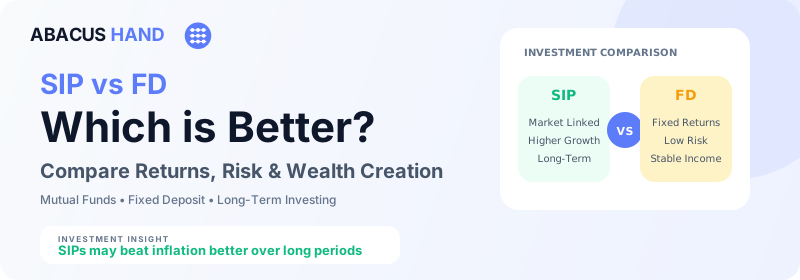
SIP (Systematic Investment Plan) and FD (Fixed Deposit) are two of India's most popular investment options. While FDs offer safety and guaranteed returns, SIPs provide the potential for wealth creation through market-linked growth. Let's compare them across every important parameter.
Understanding SIP
A SIP allows you to invest a fixed amount regularly (monthly/quarterly) in mutual funds. Your money is invested in stocks, bonds, or a mix, depending on the fund type. SIPs benefit from rupee cost averaging — you buy more units when markets are low and fewer when high. You can estimate your investment growth using our free SIP calculator.
Understanding FD
A Fixed Deposit is a lump-sum investment with a bank or NBFC for a fixed tenure at a predetermined interest rate. Your principal is safe, and returns are guaranteed regardless of market conditions.
Returns Comparison
Historical returns comparison:
- FD returns: 6-7.5% per annum (pre-tax)
- Equity SIP returns: 12-15% per annum (10-year average)
- Debt fund SIP returns: 7-9% per annum
- After tax, FD effective returns drop to 4.5-5.5% for 30% tax bracket
- Equity SIP held 1+ year: 10% LTCG tax only on gains above ₹1 lakh
Risk Assessment
Risk levels:
- FD: Zero market risk. Principal is guaranteed (up to ₹5 lakh under DICGC insurance)
- SIP in equity funds: Moderate to high short-term risk, but historically positive over 7+ years
- SIP in debt funds: Low risk, slightly higher than FD
- SIP in hybrid funds: Moderate risk with balanced growth
Tax Efficiency
FD interest is fully taxable at your income tax slab rate. If you're in the 30% bracket, your effective FD return of 7% becomes just 4.9% after tax. Equity SIPs held over 1 year attract only 10% LTCG tax on gains exceeding ₹1 lakh — making them significantly more tax-efficient for long-term investors. Estimate your fixed deposit returns and maturity amount using our FD calculator.
Liquidity
Liquidity comparison:
- FD: Premature withdrawal possible but attracts 0.5-1% penalty
- SIP (equity): Can redeem anytime, money in account within 2-3 business days
- SIP (ELSS): 3-year lock-in period for tax-saving funds
- FD (tax-saver): 5-year lock-in, no premature withdrawal
When to Choose SIP
SIP is better when:
- Your investment horizon is 5+ years
- You want to beat inflation and create wealth
- You can tolerate short-term market fluctuations
- You want tax-efficient returns
- You're saving for long-term goals like retirement or children's education
When to Choose FD
FD is better when:
- You need guaranteed, predictable returns
- Your investment horizon is short (1-3 years)
- You're building an emergency fund
- You're a senior citizen needing regular income
- You have zero risk tolerance
The best strategy for most people is a combination: keep 6 months' expenses in FD as emergency fund, and invest the rest through SIPs for long-term wealth creation.
Real Example: ₹10,000/month for 10 Years
If you invest ₹10,000/month for 10 years: In FD at 7% (compounded quarterly), you'd accumulate approximately ₹17.3 lakh. In an equity SIP averaging 12% returns, you'd accumulate approximately ₹23.2 lakh. That's a difference of nearly ₹6 lakh — the power of compounding at higher rates.
Compare your SIP and FD returns side by side
Use SIP CalculatorFrequently Asked Questions
Yes, for horizons of 5 years or longer, equity and hybrid mutual fund SIPs historically beat bank FDs. Over a 5-year period, equity SIPs typically generate 11%–14% annualized returns compared to 6.5%–7.5% from bank FDs. However, for short-term goals under 3 years where principal safety is required, bank FDs or debt funds are preferable.
Investing ₹10,000 per month (total investment ₹12 Lakhs over 10 years): at a 7% bank FD rate, your maturity corpus will be approximately ₹17.3 Lakhs (gain of ₹5.3 Lakhs). At a 12% mutual fund SIP return, your maturity corpus reaches approximately ₹23.2 Lakhs (gain of ₹11.2 Lakhs) — delivering over ₹5.9 Lakhs in additional wealth due to compounding.
Bank FD interest is added directly to your taxable income and taxed at your marginal slab rate (up to 30% + cess) every year, with TDS deducted if interest exceeds ₹40,000 (₹50,000 for senior citizens). In contrast, equity mutual fund SIPs are taxed only upon redemption: Long-Term Capital Gains (holding > 1 year) are exempt up to ₹1.25 Lakhs per financial year, with gains above ₹1.25 Lakh taxed at a flat 12.5%.
Bank FDs guarantee principal and interest up to ₹5 Lakhs per bank under DICGC insurance. Equity mutual fund SIPs are market-linked and fluctuate in the short term (1–3 years). However, historical data from Nifty 50 shows that no SIP held for 7+ years has ever generated negative returns in India, making time in the market the ultimate risk-reducer.