Data last verified: May 2026
Top-Up Loan vs Personal Loan: Which is Better?
Compare top-up loans vs personal loans in India. Understand interest rates, eligibility, processing time, and when each option saves you money on borrowing.
Ranveer Patel is a finance professional and founder of AbacusHand. She specialises in EMI & loan planning, income tax under old and new regimes, and SIP investment analysis for Indian households. Every calculator and article on AbacusHand is personally reviewed by her for accuracy.
When you need additional funds while already repaying a home loan or car loan, you face a common dilemma: should you take a top-up loan on your existing loan or apply for a fresh personal loan? The answer can save you ₹1-5 lakh in interest depending on the amount and tenure. Top-up loans offer lower interest rates (8.5-10.5%) since they're secured against your existing collateral, while personal loans (10.5-16%) provide faster disbursement and no collateral requirement. Let's break down which option works better for different scenarios.
What is a Top-Up Loan?
A top-up loan is an additional loan amount sanctioned over and above your existing home loan or car loan by the same lender. Since the original collateral (property or vehicle) already secures the loan, the bank extends additional credit at rates close to your existing loan rate — typically 0.25-1% higher than your home loan rate. For example, if your home loan rate is 8.5%, the top-up might be at 8.75-9.5%. The top-up amount is limited by the gap between your property's current value and outstanding loan balance. Plan your home buying journey by computing your EMIs with our home loan calculator.
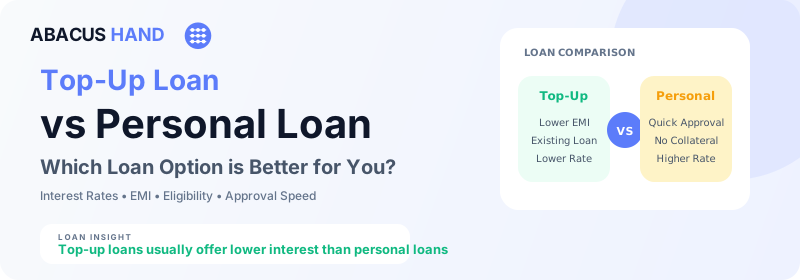
Top-Up Loan vs Personal Loan: Key Comparison
Here's a detailed comparison across all important parameters:
- Interest Rate: Top-up 8.5-10.5% p.a. vs Personal Loan 10.5-16% p.a.
- Loan Amount: Top-up limited by property value gap vs Personal Loan up to ₹40 lakh based on income
- Tenure: Top-up up to remaining home loan tenure (15-20 years) vs Personal Loan max 5-7 years
- Processing Time: Top-up 3-7 days (existing customer) vs Personal Loan 1-3 days (instant for pre-approved)
- Documentation: Top-up minimal (existing customer) vs Personal Loan standard income/identity docs
- Collateral: Top-up uses existing property/vehicle vs Personal Loan no collateral needed
- Usage Restriction: Top-up may have restrictions (some banks) vs Personal Loan no restrictions
- Tax Benefit: Top-up eligible if used for home renovation/purchase vs Personal Loan no tax benefit
- Prepayment Charges: Top-up usually nil (floating rate) vs Personal Loan 2-5% of outstanding
Interest Cost Comparison: Real Numbers
Let's compare borrowing ₹10 lakh through both options. Personal Loan at 12% for 5 years: EMI ₹22,244, total interest ₹3,34,667. Top-Up Loan at 9% for 10 years: EMI ₹12,668, total interest ₹5,20,108. Top-Up Loan at 9% for 5 years: EMI ₹20,758, total interest ₹2,45,499. If you can afford the higher EMI, a 5-year top-up saves ₹89,168 compared to the personal loan. Even the 10-year top-up, despite higher total interest, has a monthly EMI that's ₹9,576 lower — crucial if cash flow is tight. Check your potential monthly outflows using our personal loan calculator.
Always choose the shortest tenure you can afford for top-up loans. The low EMI of longer tenures is tempting, but you end up paying significantly more in total interest. A 5-year top-up at 9% costs ₹2.45 lakh in interest vs ₹5.20 lakh for 10 years.
When Top-Up Loan is the Better Choice
Choose a top-up loan when: you have an existing home loan with good repayment history (12+ months), you need ₹5-50 lakh and can wait 3-7 days for processing, you want the lowest possible interest rate, you plan to use funds for home renovation or improvement (tax benefit available), or you want a longer repayment tenure to keep EMI manageable. Top-up is especially advantageous for amounts above ₹10 lakh where the 2-4% interest rate difference translates to substantial savings.
When Personal Loan is the Better Choice
Choose a personal loan when: you need money urgently (same-day disbursement possible), the amount is small (₹1-3 lakh where interest difference is minimal), you don't have an existing home loan or your property has no equity gap, you want no connection between your home and the new debt, or you plan to prepay quickly (within 1-2 years). For a ₹2 lakh loan repaid in 2 years, the interest difference between 9% and 12% is only ₹6,400 — not worth the longer processing time of a top-up.
Eligibility for Top-Up Loan
You can avail a top-up loan if you meet these criteria:
- Existing home loan with the same bank for at least 12-24 months
- Clean repayment track record — no missed EMIs in last 12 months
- Sufficient equity in property (current value minus outstanding loan)
- CIBIL score 700+ (some banks accept 650+ for existing customers)
- EMI-to-income ratio remains below 50-60% after top-up
- Property value has appreciated or outstanding has reduced significantly
How Much Top-Up Can You Get?
The top-up amount depends on the equity available in your property. Formula: Maximum Top-Up = (Property Current Value × LTV Ratio) - Outstanding Loan. Example: Property current value ₹80 lakh, LTV ratio 75%, outstanding home loan ₹35 lakh. Maximum top-up = (₹80 lakh × 0.75) - ₹35 lakh = ₹60 lakh - ₹35 lakh = ₹25 lakh. In practice, banks may offer less than the maximum based on your income and repayment capacity. Some banks cap top-up at ₹50 lakh or 100% of outstanding loan, whichever is lower.
Tax Benefits on Top-Up Loans
Top-up loans offer tax benefits that personal loans don't — but only if used for specific purposes. If used for home purchase, construction, or renovation: interest is deductible under Section 24(b) up to ₹2 lakh (combined with existing home loan interest claim) and principal under Section 80C up to ₹1.5 lakh. If used for business: entire interest is deductible as business expense. If used for personal purposes (wedding, travel): no tax benefit. Keep clear documentation of fund usage — the bank doesn't restrict usage, but the IT department may ask for proof during assessment.
If you're using a top-up loan for home renovation, maintain all bills and receipts from contractors. The Income Tax department may ask for proof that the top-up amount was actually used for property improvement.
Top-Up on Home Loan vs Top-Up on Car Loan
Top-up on home loan is far more advantageous than top-up on car loan. Home loan top-up rates are 8.5-10.5% with tenure up to 15-20 years and potential tax benefits. Car loan top-up rates are 10-14% with tenure limited to remaining car loan period (usually 2-4 years) and no tax benefits. Car loan top-ups are also limited by the vehicle's depreciating value — a 3-year-old car worth ₹6 lakh with ₹3 lakh outstanding might only qualify for ₹1-2 lakh top-up. For larger amounts, a home loan top-up is always preferable.
Balance Transfer with Top-Up: Best of Both Worlds
Many borrowers combine a home loan balance transfer with a top-up to get both a lower rate on existing loan AND additional funds. Example: Your current home loan is ₹40 lakh at 9.5% with Bank A. Bank B offers balance transfer at 8.5% plus ₹15 lakh top-up at 9%. You save on existing loan interest AND get additional funds at a rate lower than any personal loan. Banks actively compete for balance transfer customers, often waiving processing fees and offering attractive top-up terms. This strategy works best when your existing rate is 0.5%+ higher than market rates.
Common Mistakes to Avoid
Avoid these pitfalls when choosing between top-up and personal loans:
- Don't take a 15-year top-up for a short-term need — you'll pay 3x more interest than necessary
- Don't assume top-up is always cheaper — for small amounts (under ₹2 lakh) repaid quickly, personal loan may be simpler
- Don't forget processing fees — top-up charges 0.25-0.5% which adds up on large amounts
- Don't mix top-up with home loan EMI mentally — track them separately for financial clarity
- Don't take top-up if your property is already highly leveraged (LTV above 80%)
- Don't ignore prepayment flexibility — ensure your top-up allows penalty-free prepayment
Calculate and compare EMI for top-up loan vs personal loan for your specific amount
Use Top-Up vs Personal Loan CalculatorFrequently Asked Questions
Not exactly. Top-up loan rates are typically 0.25-1% higher than your existing home loan rate. If your home loan is at 8.5%, the top-up might be at 8.75-9.5%. This is still significantly lower than personal loan rates of 10.5-16%. Some banks offer the same rate as the home loan for existing customers with excellent repayment history.
Most banks don't restrict the end-use of top-up loans — you can use it for business, education, medical expenses, wedding, or any personal need. However, to claim tax benefits, the funds must be used for home purchase/renovation (Section 24b) or business purposes. Keep documentation of fund usage for tax purposes.
For existing home loan customers with clean repayment history, top-up loans are typically approved in 3-7 working days. Some banks offer pre-approved top-ups that can be availed instantly through net banking. Personal loans, in comparison, can be disbursed within 24 hours for pre-approved customers.
No, top-up loans are only available from your existing home loan lender since they already hold the property as collateral. To get a top-up from another bank, you'd need to first do a balance transfer of your home loan to that bank, and then avail the top-up. Many banks offer attractive balance transfer + top-up combo deals.