Data last verified: June 2026
Stamp Duty & Registration Charges: Complete Guide for Home Buyers
Complete guide to stamp duty and registration charges for Indian home buyers — state-wise rates for Maharashtra, Karnataka, Delhi, UP, Gujarat, women buyer concessions, calculation method, and ways to save legally.
Ranveer Patel is a finance professional and founder of AbacusHand. She specialises in EMI & loan planning, income tax under old and new regimes, and SIP investment analysis for Indian households. Every calculator and article on AbacusHand is personally reviewed by her for accuracy.
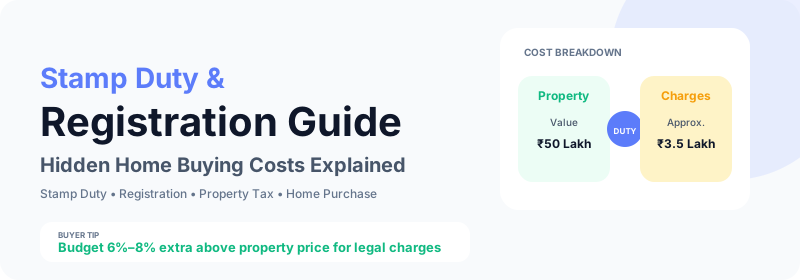
You've finally found the perfect apartment, negotiated the price down to ₹80 lakh, and you're feeling good about the deal. Then the builder casually mentions 'stamp duty and registration is extra — that'll be ₹5-6 lakh.' If you're a first-time home buyer, this comes as a shock. Nobody told you that buying a house costs 5-8% more than the actual property price, just in government charges. And you can't skip it — no stamp duty means no legal ownership.
I've seen first-time buyers run out of budget at this stage because they didn't factor these costs into their planning. This guide helps you understand exactly what you'll pay, state-wise rates, and legitimate ways to reduce these charges. You can use our free EMI calculator to instantly verify these calculations.
Stamp duty rates are set by individual state governments and can change through state budget announcements or special schemes. The rates mentioned in this article are indicative as of May 2026. Always verify current rates on your state's stamp duty portal or with your registration sub-office before making payments.
What is Stamp Duty and Registration?
Stamp duty is a tax levied by the state government on property transactions. It's your payment to the government for legally recording the transfer of property ownership. Registration charges are a separate fee paid to the sub-registrar's office for actually registering the sale deed in government records.
Without paying stamp duty and registering the property, your sale deed has no legal standing. You won't get mutation done, you can't get a home loan against it (bank requires registered documents), and in a dispute, an unregistered sale deed carries no legal weight. It's non-negotiable. Plan your home buying journey by computing your EMIs with our home loan calculator.
Stamp duty vs registration — the difference:
- Stamp duty: Tax on the transaction (paid to state government treasury) — typically 4-7% of property value
- Registration charges: Fee for recording the transaction (paid to sub-registrar) — typically 1% of property value
- Both are calculated on: Agreement value OR circle rate/ready reckoner rate — whichever is HIGHER
- Additional charges may include: Local body tax (LBT), metro cess, surcharge (varies by state)
- Total out-of-pocket: Typically 5-8% of property value depending on state
State-Wise Stamp Duty Rates (2026)
Stamp duty rates vary significantly across states. Here are the major ones that cover 70%+ of property transactions in India:
Maharashtra (Mumbai, Pune, Nagpur, Thane):
- Stamp duty: 5% (within municipal limits of Mumbai) | 6% (rest of Maharashtra)
- Registration: 1% of property value (capped at ₹30,000)
- Additional: 1% metro cess in Mumbai Metropolitan Region
- Women buyers: 1% concession on stamp duty (4% instead of 5% in Mumbai)
- Total for a ₹1 crore property (Mumbai, male buyer): approximately ₹7 lakh
Karnataka (Bangalore, Mysore):
- Stamp duty: 5% (properties above ₹45 lakh) | 3% (₹21-45 lakh) | 2% (below ₹20 lakh)
- Registration: 1% of property value
- Additional: 10% surcharge on stamp duty + 2% cess
- BBMP (Bangalore) properties often have higher circle rates than actual market value
- Total for a ₹1 crore property (Bangalore): approximately ₹6.7 lakh
Delhi NCR (Delhi proper):
- Stamp duty: 4% (women) | 6% (men) | 5% (joint male+female)
- Registration: 1% of property value
- Women get a clear 2% benefit in Delhi — significant on high-value properties
- Total for a ₹1 crore property (Delhi, male): approximately ₹7 lakh
Uttar Pradesh (Noida, Greater Noida, Lucknow, Ghaziabad):
- Stamp duty: 7% (men) | 6% (women) in urban areas
- Registration: 1% of property value (minimum ₹15,000)
- UP has among the highest stamp duty rates in India
- Total for a ₹80 lakh property (Noida, male): approximately ₹6.4 lakh
Gujarat (Ahmedabad, Surat, Vadodara):
- Stamp duty: 4.9% (includes surcharge)
- Registration: 1% of property value
- No gender-based concession in Gujarat
- Total for a ₹70 lakh property: approximately ₹4.13 lakh
How to Calculate Your Total Stamp Duty and Registration Cost
The calculation is based on the HIGHER of two values: (a) the actual agreement value (price you're paying to the seller), or (b) the government's circle rate/ready reckoner rate for that area.
Let me work through a real example. Priya is buying a 2BHK in Thane, Maharashtra for ₹75 lakh. The ready reckoner rate for her building's area is ₹80 lakh. Since circle rate is higher, stamp duty is calculated on ₹80 lakh.
Priya's calculation (woman buyer in Thane):
- Stamp duty: 5% of ₹80 lakh = ₹4,00,000 (she gets 1% concession as woman = ₹3,20,000 at 4%)
- Registration: 1% of ₹80 lakh = ₹80,000 (but capped at ₹30,000 in Maharashtra)
- Metro cess: 1% of ₹80 lakh = ₹80,000
- Total: ₹3,20,000 + ₹30,000 + ₹80,000 = ₹4,30,000
- Compare with male buyer: ₹4,00,000 + ₹30,000 + ₹80,000 = ₹5,10,000
- Savings for being a woman buyer: ₹80,000
Pro tip: If the circle rate for your area is unreasonably high compared to actual market value, you still pay stamp duty on the circle rate. However, some states allow you to file for reassessment. In Maharashtra, you can appeal to the Collector if the ready reckoner rate seems inflated for your specific property.
Women Buyer Concession: How to Save ₹50,000-₹2 Lakh
Many states offer reduced stamp duty for women buyers. If you're buying a house and there's a woman in the family (wife, mother, daughter), seriously consider registering in her name or as a joint owner. The savings are substantial:
State-wise women buyer benefits:
- Maharashtra: 1% less stamp duty for women (saves ₹40,000-₹1 lakh on most properties)
- Delhi: 2% less stamp duty (4% vs 6% — saves ₹80,000-₹2 lakh on Delhi properties)
- Rajasthan: 1% less stamp duty for women
- Haryana: 2% concession for women in urban areas
- UP: 1% less for women (6% vs 7%)
- Punjab: Flat ₹2% less for women buyers
Even in states without explicit women's concession (Gujarat, Karnataka), registering in a woman's name has no downside and might benefit future tax planning (if she has lower income, capital gains on future sale may be taxed less). Joint ownership with your spouse is the most common and practical approach.
Legitimate Ways to Save on Stamp Duty
Legal strategies to reduce stamp duty burden:
- Register in a woman's name where state concessions apply (savings: 1-2% of property value)
- Buy during government stamp duty reduction schemes (Maharashtra did this during COVID — saved buyers 2-3%)
- Purchase under-construction property (lower stamp duty base since only construction cost at that stage in some states)
- Joint registration with woman co-owner qualifies for reduced rate in most states
- Check if your property falls under 'affordable housing' definition for state-specific concessions
- In some states, PMAY beneficiaries get stamp duty reduction on first home purchase
- Never undervalue the property (paying on less than circle rate) — this is illegal and attracts penalties
Online Payment Process: How to Pay Stamp Duty
Most states now allow online stamp duty and registration. Here's the typical process:
Step-by-step online payment:
- Step 1: Visit your state's stamps and registration portal (e.g., IGR Maharashtra, Kaveri Online Karnataka)
- Step 2: Generate e-stamp paper for the calculated amount (via SHCIL authorized centers or bank branches)
- Step 3: Book an appointment at the Sub-Registrar Office (SRO) for document registration
- Step 4: Both buyer and seller visit SRO with original documents, witnesses, and PAN/Aadhaar
- Step 5: Biometric verification and photograph capture at SRO
- Step 6: Pay registration fee (online or at counter)
- Step 7: Registered document available for download within 1-3 working days
- Step 8: Apply for mutation at local municipal body with registered sale deed
A couple of practical notes: keep extra copies of the e-stamp certificate (in case of errors during registration). Carry original property documents including the previous chain of title deeds. If the seller is an NRI, additional documentation (POA, TDS certificates) will be needed.
Factoring Stamp Duty Into Your Home Buying Budget
This is the most important practical takeaway. When you budget for buying a house, add 8-10% on top of the property price for all costs:
Total cost beyond property price:
- Stamp duty: 4-7% (varies by state and gender)
- Registration charges: 1% (often capped at ₹30,000)
- Legal fees (advocate for document verification): ₹15,000-50,000
- Home loan processing fee: 0.25-0.5% of loan amount
- GST (if under-construction from builder): 1-5% depending on project type
- Interior and move-in costs: ₹3-10 lakh depending on property size
- Society transfer charges (resale property): ₹25,000-₹1 lakh
So if you're looking at a ₹1 crore apartment, your actual budget needs to be ₹1.08-1.10 crore minimum. Banks will NOT include stamp duty in your home loan amount (some offer top-up for it, but at higher rates). You need this money from your own pocket. Factor this into your down payment planning.
Pro tip: Many buyers forget that stamp duty is payable before or during registration — not after. You cannot register the property and pay later. Have the full stamp duty amount ready in your bank account before the registration date. E-stamps typically need to be purchased 1-2 days before the registration appointment.
Calculate your complete home buying cost including EMI, down payment, and stamp duty to plan your budget accurately.
Use Home Loan CalculatorFrequently Asked Questions
In Maharashtra, stamp duty is 5% within Mumbai municipal limits (4% for women) and 6% in the rest of Maharashtra (5% for women). Additionally, there's a 1% metro cess in the Mumbai Metropolitan Region and registration charges of 1% (capped at ₹30,000). Total cost for a male buyer in Mumbai is approximately 7% of property value.
Stamp duty is calculated on whichever is HIGHER — the actual agreement value (price you're paying) or the government's circle rate (ready reckoner rate in Maharashtra, guidance value in Karnataka). If you buy below circle rate, you still pay stamp duty on the circle rate. Registering below circle rate can also trigger income tax implications for both buyer and seller.
Savings vary by state. In Delhi, women get 2% concession (saves ₹2 lakh on a ₹1 crore property). In Maharashtra, 1% concession (saves ₹1 lakh on ₹1 crore). In UP, 1% less. Joint registration with wife as first holder also qualifies for the women's rate in most states. Additional benefit: if she's a co-borrower on the home loan, her lower income tax bracket may help with future capital gains.
Standard home loans do not cover stamp duty — banks finance only the property value (typically 75-90% LTV). However, some banks offer a separate 'stamp duty and registration' top-up at slightly higher interest rates. Alternatively, you can take a personal loan for this amount. Most financial advisors recommend budgeting stamp duty separately from your down payment savings.
If you've paid stamp duty but the registration hasn't been completed, you can apply for a refund within 6 months in most states (with a deduction of 10% as processing fee). However, once the document is registered, stamp duty is non-refundable regardless of whether the property transaction is later cancelled or disputed.