Data last verified: May 2026
Section 80C Deductions (2026): Complete List of Tax-Saving Options
Complete guide to Section 80C deductions for 2026. Explore PPF, ELSS, NPS, LIC, EPF, and home loan principal to save up to ₹46,800 in taxes under Old Regime.
Ranveer Patel is a finance professional and founder of AbacusHand. She specialises in EMI & loan planning, income tax under old and new regimes, and SIP investment analysis for Indian households. Every calculator and article on AbacusHand is personally reviewed by her for accuracy.
Section 80C of the Income Tax Act, 1961 is the most popular tax-saving provision in India. It allows individuals and HUFs to claim deductions of up to ₹1,50,000 per financial year on specified investments and expenses. If you're in the 30% tax bracket, this single section can save you ₹46,800 in taxes (including cess). Understanding all available options under 80C helps you make smarter investment decisions while reducing your tax liability.
What is Section 80C?
Section 80C is a deduction from your gross total income that reduces your taxable income. The maximum deduction limit is ₹1,50,000 per financial year. This deduction is available only under the Old Tax Regime — if you've opted for the New Tax Regime, you cannot claim 80C benefits. The deduction covers a wide range of investments, insurance premiums, and certain expenditures.
Section 80C deduction is only available under the Old Tax Regime. If you've chosen the New Tax Regime (default from FY 2023-24), you cannot claim this deduction. Use our income tax calculator to compare both regimes.
Complete List of Section 80C Investments
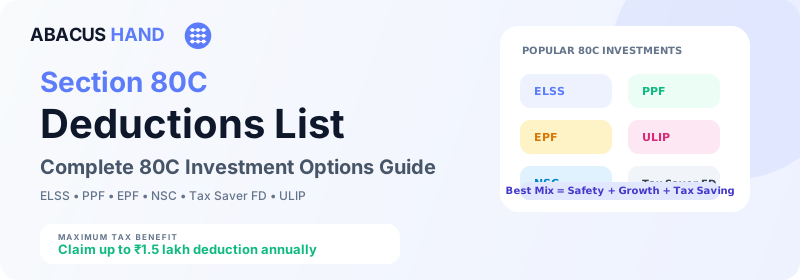
Here's every investment and expense that qualifies for deduction under Section 80C. The combined limit across all these options is ₹1,50,000.
Employee Provident Fund (EPF)
EPF is the most common 80C investment for salaried employees. Your employer deducts 12% of your basic salary as your EPF contribution, which automatically qualifies for 80C deduction. For someone with a basic salary of ₹50,000/month, the annual EPF contribution is ₹72,000 — already covering nearly half of the 80C limit. EPF currently earns 8.25% interest (FY 2023-24), which is tax-free up to ₹2.5 lakh annual contribution.
Public Provident Fund (PPF)
PPF is a government-backed savings scheme with a 15-year lock-in period. The current interest rate is 7.1% per annum, compounded annually. You can invest between ₹500 and ₹1,50,000 per year. PPF enjoys EEE (Exempt-Exempt-Exempt) status — the investment, interest earned, and maturity amount are all tax-free. This makes PPF one of the safest and most tax-efficient options for conservative investors. Project your PPF interest earnings and maturity value using our PPF calculator.
Equity Linked Savings Scheme (ELSS)
ELSS mutual funds have the shortest lock-in period among 80C options — just 3 years. They invest primarily in equities and have historically delivered 12-15% CAGR over long periods. Unlike PPF, ELSS returns are market-linked, so there's no guaranteed return. However, the potential for higher returns and shorter lock-in make ELSS popular among young investors. Long-term capital gains above ₹1.25 lakh are taxed at 12.5%.
National Pension System (NPS)
NPS offers an additional ₹50,000 deduction under Section 80CCD(1B), over and above the ₹1.5 lakh limit of 80C. Your own contribution up to 10% of salary qualifies under 80C (within the ₹1.5 lakh limit), while the extra ₹50,000 is a bonus deduction. NPS invests in a mix of equity, corporate bonds, and government securities based on your chosen allocation. The lock-in is until age 60, making it a long-term retirement tool.
Life Insurance Premium
Premiums paid for life insurance policies (for self, spouse, or children) qualify under 80C. This includes term insurance, endowment plans, ULIPs, and whole life policies. However, the premium should not exceed 10% of the sum assured (for policies issued after April 2012) to qualify for tax benefits. Term insurance is recommended as it provides maximum coverage at the lowest premium.
Other 80C Eligible Investments
Additional investments qualifying under Section 80C:
- 5-Year Tax Saving Fixed Deposit: Interest rate 6.5-7.5% (taxable interest)
- National Savings Certificate (NSC): 7.7% interest, 5-year lock-in
- Sukanya Samriddhi Yojana (SSY): 8.2% interest, for girl child (highest among small savings)
- Senior Citizens Savings Scheme (SCSS): 8.2% interest, for 60+ age group
- Unit Linked Insurance Plans (ULIPs): Market-linked returns with insurance cover
- Infrastructure Bonds: Issued by NHAI, REC, PFC etc.
Expenses That Qualify Under 80C
These expenditures also count towards your ₹1.5 lakh 80C limit:
- Children's tuition fees: Up to 2 children, full-time education in India
- Home loan principal repayment: EMI principal component qualifies
- Stamp duty and registration charges: Paid for house purchase (one-time)
- Post Office Time Deposit: 5-year term deposit at post office
Section 80C Tax Savings Calculation
The actual tax saved depends on your income tax slab. Here's how much you save by investing the full ₹1,50,000 under 80C:
Tax savings at different income levels (Old Regime):
- Income ₹5-10 lakh (20% slab): Save ₹31,200 (₹30,000 + 4% cess)
- Income above ₹10 lakh (30% slab): Save ₹46,800 (₹45,000 + 4% cess)
- Income ₹2.5-5 lakh (5% slab): Save ₹7,800 (₹7,500 + 4% cess)
Your EPF contribution is automatically deducted from salary and counts towards 80C. Calculate your remaining 80C limit after EPF before making additional investments.
Best 80C Investment Strategy by Age
Your ideal 80C portfolio depends on your age, risk appetite, and financial goals. Here's a recommended allocation:
For age 25-35 (aggressive growth):
- EPF: ₹50,000-72,000 (automatic from salary)
- ELSS: ₹50,000-80,000 (high growth potential, 3-year lock-in)
- Term Insurance: ₹10,000-15,000 (essential protection)
- NPS (80CCD 1B): ₹50,000 extra (additional deduction beyond ₹1.5L)
For age 35-50 (balanced approach):
- EPF: ₹60,000-84,000 (automatic)
- PPF: ₹30,000-50,000 (safe, guaranteed returns)
- ELSS: ₹30,000-50,000 (equity exposure)
- Children's tuition fees: As applicable
- Home loan principal: As applicable
For age 50+ (conservative):
- EPF/VPF: Maximize contribution
- PPF: ₹50,000-1,00,000 (safe, tax-free returns)
- SCSS: ₹50,000+ (high interest for seniors)
- 5-Year Tax FD: For remaining limit
Common Mistakes to Avoid
Avoid these common 80C mistakes:
- Buying insurance just for tax saving — term plan is sufficient for protection
- Ignoring EPF contribution — it already counts towards 80C
- Investing in low-return options when you have a long time horizon
- Last-minute investments in March without proper planning
- Not considering lock-in periods before investing
- Forgetting that tuition fees and home loan principal also qualify
Section 80C vs Other Deductions
Section 80C is just one part of tax planning. Other important sections include 80D (health insurance up to ₹1 lakh), 80E (education loan interest — no limit), 80G (donations), and 80CCD(1B) (additional ₹50,000 for NPS). A comprehensive tax plan uses multiple sections together to maximize savings.
How to Claim 80C Deduction
Steps to claim your 80C deduction:
- Submit investment proofs to your employer before January deadline
- Keep receipts, statements, and premium payment proofs
- Declare investments in Form 12BB to employer for TDS adjustment
- Report all 80C investments while filing ITR under 'Deductions' section
- Choose Old Tax Regime to avail 80C benefits
Calculate your exact tax savings with Section 80C and 80D deductions
Use 80C & 80D Tax MaximizerFrequently Asked Questions
The maximum deduction under Section 80C is ₹1,50,000 per financial year. This is a combined limit — all your 80C investments (EPF, PPF, ELSS, insurance, etc.) together cannot exceed ₹1.5 lakh for deduction purposes.
No, Section 80C deduction is not available under the New Tax Regime. You must opt for the Old Tax Regime to claim 80C benefits. However, employer's NPS contribution under 80CCD(2) is available in both regimes.
ELSS is better for higher returns (12-15% historical CAGR) and shorter lock-in (3 years). PPF is better for guaranteed returns (7.1%), complete tax-free status (EEE), and zero risk. Choose ELSS if you can handle market volatility and have 5+ year horizon; choose PPF for safety.
Yes, your employee contribution to EPF (12% of basic salary) automatically qualifies under Section 80C. If your basic salary is ₹50,000/month, your annual EPF contribution of ₹72,000 is already counted towards the ₹1.5 lakh limit.
Yes, tuition fees paid for up to 2 children for full-time education in any school, college, or university in India qualifies under 80C. This includes school fees but excludes development fees, donations, transport charges, and hostel fees.