Data last verified: May 2026
PPF vs ELSS: Which Tax-Saving Investment is Better?
Compare PPF and ELSS tax-saving investments across returns, lock-in period, risk, and tax benefits under Section 80C. Make the right choice for your goals.
Ranveer Patel is a finance professional and founder of AbacusHand. She specialises in EMI & loan planning, income tax under old and new regimes, and SIP investment analysis for Indian households. Every calculator and article on AbacusHand is personally reviewed by her for accuracy.
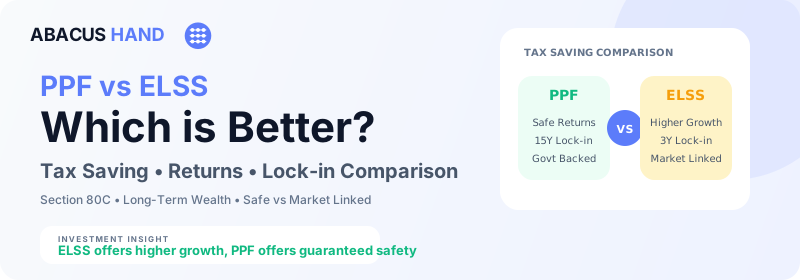
When it comes to saving tax under Section 80C of the Income Tax Act, PPF (Public Provident Fund) and ELSS (Equity Linked Savings Scheme) are two of the most popular options among Indian investors. Both offer tax deductions up to ₹1.5 lakh per year, but they differ significantly in returns, risk, lock-in period, and overall wealth creation potential. This comprehensive guide will help you decide which one suits your financial profile better.
Important Disclaimer
- This article is for educational and informational purposes only and does NOT constitute financial, investment, or tax advice.
- Returns mentioned (PPF rate 7.1%, ELSS historical 12–18%) are indicative/historical and NOT guaranteed.
- Readers should consult a SEBI-registered investment advisor or certified financial planner before making investment decisions.
- The author is not a SEBI-registered advisor. Past performance of ELSS funds does not guarantee future results.
What is PPF?
Public Provident Fund (PPF) is a government-backed savings scheme with a 15-year lock-in period. It offers guaranteed returns at a rate set by the government every quarter. As of Q1 FY2025-26, the PPF interest rate remains 7.1% per annum (unchanged since April 2020), compounded annually. The rate is reviewed quarterly by the Ministry of Finance — always verify the current rate at the India Post or SBI official website before investing. PPF enjoys EEE (Exempt-Exempt-Exempt) tax status — your investment, interest earned, and maturity amount are all tax-free. Project your PPF interest earnings and maturity value using our PPF calculator.
Key features of PPF:
- Minimum investment: ₹500/year, Maximum: ₹1.5 lakh/year
- Lock-in period: 15 years (partial withdrawal after 7 years)
- Interest rate: 7.1% p.a. (Q1 FY2025-26, unchanged since April 2020), revised quarterly by government
- Tax benefit: EEE status — investment, interest, and maturity all tax-free
- Risk level: Zero — backed by Government of India sovereign guarantee
- Loan facility available from 3rd to 6th financial year
What is ELSS?
ELSS (Equity Linked Savings Scheme) is a type of mutual fund that invests primarily in equities and qualifies for tax deduction under Section 80C. It has the shortest lock-in period among all 80C investments — just 3 years. ELSS funds are managed by professional fund managers and have historically delivered 12-18% annualized returns over long periods, though returns are not guaranteed.
Key features of ELSS:
- Minimum investment: As low as ₹500 (SIP) or ₹1,000 (lump sum)
- Lock-in period: 3 years (shortest among all 80C options)
- Historical returns: 12-18% CAGR over 10+ year periods
- Tax on gains: 10% LTCG tax on gains exceeding ₹1 lakh per year
- Risk level: Moderate to high (market-linked returns)
- Can invest via SIP or lump sum
Returns Comparison: PPF vs ELSS
Let's compare what happens when you invest ₹1.5 lakh per year (the maximum 80C limit) in both PPF and ELSS over different time horizons. For ELSS, we'll use a conservative 12% annual return assumption based on Nifty 50 historical performance.
Investment of ₹1.5 lakh/year comparison:
- After 10 years — PPF: ₹21.7 lakh | ELSS (12%): ₹26.4 lakh
- After 15 years — PPF: ₹40.7 lakh | ELSS (12%): ₹49.9 lakh
- After 20 years — PPF: ₹66.6 lakh | ELSS (12%): ₹99.1 lakh
- After 25 years — PPF: ₹1.03 crore | ELSS (12%): ₹1.78 crore
- Difference over 25 years: ₹75 lakh more with ELSS (before tax on gains)
Past ELSS returns don't guarantee future performance. While Nifty 50 has delivered ~12% CAGR over 20 years, individual years can see -20% to +50% swings. PPF returns are guaranteed but may not beat inflation significantly.
Tax Treatment Comparison
PPF enjoys complete tax exemption under EEE status. Your ₹1.5 lakh investment gets 80C deduction, the interest earned is tax-free, and the maturity amount is completely tax-free. ELSS also gets 80C deduction on investment, but gains above ₹1 lakh in a financial year attract 10% LTCG tax (without indexation benefit). For example, if your ELSS gains are ₹3 lakh in a year, you pay 10% tax on ₹2 lakh = ₹20,000.
Risk and Volatility
PPF carries zero market risk as it's backed by the Government of India. Your principal is 100% safe, and returns are guaranteed at the declared rate. ELSS, being equity-linked, can see significant short-term volatility. During the 2020 COVID crash, many ELSS funds fell 30-40% in weeks. However, those who stayed invested saw full recovery within 12-18 months and went on to earn 15%+ returns over the next 3 years.
Risk comparison:
- PPF: Zero risk, guaranteed returns, no market exposure
- ELSS: High short-term risk, but historically rewarding over 7+ years
- PPF worst case: Returns may decrease if government cuts rates (happened from 8.7% in 2016 to 7.1% where it has remained since April 2020)
- ELSS worst case: Can give negative returns in 1-3 year periods during bear markets
- ELSS best case: Top funds have delivered 15-20% CAGR over 10-year periods
Lock-in Period and Liquidity
This is where ELSS has a clear advantage. ELSS has a 3-year lock-in — the shortest among all Section 80C investments. After 3 years, you can redeem anytime. PPF has a 15-year lock-in with partial withdrawal allowed only after the 7th year (up to 50% of balance at end of 4th year). If you start a SIP in ELSS, each monthly installment has its own 3-year lock-in, meaning after the initial 3 years, some portion becomes liquid every month. You can estimate your investment growth using our free SIP calculator.
Who Should Choose PPF?
PPF is ideal for:
- Conservative investors with zero risk tolerance
- People nearing retirement who can't afford market volatility
- Those who want guaranteed, tax-free returns
- Investors who already have equity exposure through other investments
- Self-employed individuals (PPF is one of the few retirement options for them)
- Those building a debt allocation in their portfolio
Who Should Choose ELSS?
ELSS is ideal for:
- Young investors (25-40 years) with a long investment horizon
- Those who can tolerate short-term market fluctuations
- Investors seeking higher wealth creation potential
- People who want shorter lock-in with tax benefits
- Those who already have PPF/EPF for debt allocation
- Investors comfortable with equity market dynamics
The Smart Strategy: Combine Both
Most financial advisors recommend using both PPF and ELSS as part of a balanced tax-saving strategy. A common approach is to invest ₹50,000-75,000 in PPF for guaranteed returns and safety, and the remaining ₹75,000-1,00,000 in ELSS for higher growth potential. This gives you the stability of PPF with the wealth creation power of ELSS.
If you're a salaried employee, remember that your EPF contribution (employer + employee) already counts toward the ₹1.5 lakh 80C limit. Calculate your remaining 80C room before deciding PPF vs ELSS allocation.
Top ELSS Funds Performance (2025–26)
Top-performing ELSS funds (10-year CAGR, illustrative based on historical data):
- Quant Tax Plan: ~20% CAGR
- Mirae Asset Tax Saver: ~18% CAGR
- Canara Robeco Equity Tax Saver: ~16% CAGR
- Axis Long Term Equity: ~14% CAGR
- SBI Long Term Equity: ~14% CAGR
ELSS fund rankings change frequently. The above figures are illustrative based on historical 10-year CAGR data. For current NAV and updated performance, check Value Research Online (valueresearchonline.com) or AMFI India (amfiindia.com).
Calculate your PPF maturity amount and see how much you'll accumulate over 15 years
Use PPF CalculatorImportant Disclaimer
- This article is for educational and informational purposes only and does NOT constitute financial, investment, or tax advice.
- Returns mentioned (PPF rate 7.1%, ELSS historical 12–18%) are indicative/historical and NOT guaranteed.
- Readers should consult a SEBI-registered investment advisor or certified financial planner before making investment decisions.
- The author is not a SEBI-registered advisor. Past performance of ELSS funds does not guarantee future results.
Frequently Asked Questions
ELSS has historically given better returns (12-15% CAGR) compared to PPF (7.1% currently). However, ELSS returns are not guaranteed and depend on market performance. Over 10+ year periods, ELSS has outperformed PPF in most cases.
Yes, you can invest in both. The combined deduction under Section 80C is limited to ₹1.5 lakh per year. Many investors split their 80C investment between PPF (for safety) and ELSS (for growth).
ELSS carries market risk in the short term. However, with a 3-year mandatory lock-in and historically positive returns over 5+ year periods, the risk is manageable. No 5-year ELSS SIP in a diversified fund has given negative returns historically.
After 15 years, you can either withdraw the entire amount tax-free, or extend in blocks of 5 years (with or without fresh contributions). Many investors extend their PPF as it continues to earn tax-free interest.