Data last verified: May 2026
What Happens If You Miss an EMI Payment?
Learn the real consequences of missing an EMI payment in India — from penalty charges to CIBIL score damage. Plus actionable steps to recover and avoid defaults.
Ranveer Patel is a finance professional and founder of AbacusHand. She specialises in EMI & loan planning, income tax under old and new regimes, and SIP investment analysis for Indian households. Every calculator and article on AbacusHand is personally reviewed by her for accuracy.
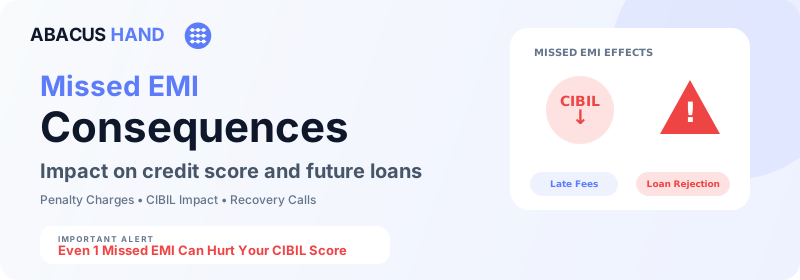
Missing an EMI payment — whether on a home loan, personal loan, or car loan — triggers a chain of consequences that can cost you far more than the missed amount. From immediate penalty charges of 1-2% per month to long-term CIBIL score damage that stays for 7 years, the impact of even a single missed EMI can be severe. In India, where over 30 crore people have active loans, understanding these consequences and knowing your recovery options is essential financial literacy.
Immediate Consequences of Missing an EMI
Here's what happens the moment you miss an EMI payment:
- Late payment fee: ₹500-1,000 flat fee or 1-2% of EMI amount (whichever is higher)
- Penal interest: Additional 1-2% p.a. charged on the overdue amount from the due date
- Bounce charges: ₹350-750 if auto-debit fails due to insufficient balance (charged by both bank and lender)
- SMS/email reminders: Lender's collection team begins contacting you within 3-7 days
- Account flagged: Your loan account is marked as 'overdue' in the lender's system
Impact on Your CIBIL Score
Payment history accounts for 35% of your CIBIL score — the single largest factor. A single missed EMI reported to CIBIL can drop your score by 50-100 points. The severity depends on how late the payment is: 30 days overdue (DPD 30) causes moderate damage, 60 days (DPD 60) causes significant damage, and 90+ days (DPD 90) is classified as NPA (Non-Performing Asset) causing severe, long-lasting damage. This negative mark stays on your credit report for 7 years from the date of the missed payment. You can use our free EMI calculator to instantly verify these calculations.
Lenders typically report to CIBIL on a monthly cycle. If you pay within 30 days of the due date, some lenders may not report it as a default — but you'll still pay penalty charges. Always pay before the 30-day mark to minimize CIBIL damage.
Timeline: What Happens After Missing EMI
Day 1-7: Late fee charged, reminder calls/SMS begin. Day 7-30: Penal interest accumulates, more frequent collection calls, account marked as 'overdue'. Day 30-60: Reported to CIBIL as DPD 30, formal notice sent, collection intensity increases. Day 60-90: DPD 60 reported, legal notice may be issued, account classified as SMA-1 (Special Mention Account). Day 90+: Account becomes NPA, CIBIL score severely damaged, legal proceedings may begin, for secured loans — SARFAESI notice for asset seizure. Day 180+: Loan may be written off, recovery agents deployed, property auction proceedings for secured loans.
Financial Cost of Missing EMIs: A Real Example
Consider a home loan with EMI of ₹35,000. If you miss one EMI: Late fee ₹500 + penal interest at 2% p.a. on ₹35,000 for 30 days = ₹58 + bounce charges ₹750 = total penalty approximately ₹1,308. Seems small? The real cost is the CIBIL damage. If your score drops from 750 to 680, your next loan (say a car loan of ₹8 lakh) might come at 10% instead of 8% — costing you ₹8,800 extra in interest over 5 years. For a future home loan top-up of ₹20 lakh, the rate difference could cost ₹2-4 lakh over 15 years.
Consequences by Loan Type
Home Loan: After 90 days of default, the bank can issue SARFAESI notice and eventually auction your property. However, banks prefer restructuring for home loans due to the large amounts involved. Car Loan: Vehicle can be repossessed after 90 days of default — car loans have the fastest repossession timelines. Personal Loan: No asset seizure possible, but aggressive recovery calls, legal notices, and potential civil suit. Credit Card: Minimum due becomes overdue, interest charged at 3.5% per month (42% p.a.), and credit limit may be reduced or card blocked. Check your potential monthly outflows using our personal loan calculator.
What to Do If You Can't Pay EMI This Month
If you know you'll miss an EMI, take these proactive steps immediately:
- Contact your lender BEFORE the due date — proactive communication shows good faith
- Request EMI holiday or moratorium (some banks offer 1-3 month relief for genuine hardship)
- Ask for loan restructuring — extending tenure reduces EMI without default
- Use emergency fund or liquidate non-essential investments to cover the EMI
- Borrow from family/friends temporarily rather than defaulting on a formal loan
- If you have multiple loans, prioritize secured loans (home/car) over unsecured ones
- Check if your loan has EMI protection insurance that covers job loss or medical emergencies
RBI Guidelines on Loan Recovery
The RBI has strict guidelines protecting borrowers from harassment. Recovery agents cannot visit before 7 AM or after 7 PM. They cannot use threatening language, physical force, or intimidation. They must identify themselves and carry authorization letters. They cannot contact your employer, neighbors, or family members about your loan. If you face harassment, file a complaint with the bank's grievance cell first, then escalate to the RBI Banking Ombudsman. Under the RBI's Fair Practices Code, banks must give 60 days notice before classifying a loan as NPA and initiating recovery.
Record all interactions with recovery agents. If they violate RBI guidelines, file a complaint at cms.rbi.org.in. Banks have been penalized heavily for recovery agent misconduct.
Loan Restructuring: Your Safety Net
If you're facing temporary financial difficulty, loan restructuring is often the best solution. Options include: tenure extension (reduces EMI by spreading payments over more months), EMI step-down (lower EMI initially, increasing later as income recovers), moratorium period (pause EMIs for 3-6 months, interest still accrues), and conversion to lower interest rate. For example, a ₹30 lakh home loan at 9% with 15 years remaining has EMI of ₹30,428. Extending tenure to 20 years reduces EMI to ₹26,992 — a ₹3,436 monthly relief. The trade-off is ₹8.5 lakh more in total interest.
How to Recover After Missing EMIs
If you've already missed EMIs, here's your recovery roadmap. Step 1: Clear all overdue amounts immediately, including penalties. Step 2: Set up auto-debit to prevent future misses. Step 3: Maintain 12 consecutive months of on-time payments to show recovery. Step 4: Check your CIBIL report after 45 days to ensure the lender updated your payment status. Step 5: If the default was due to a genuine reason (job loss, medical emergency), write to the lender requesting them to update the remark in your credit report. Some lenders accommodate this for loyal customers.
EMI Protection Insurance: Is It Worth It?
Many banks offer EMI protection insurance (also called loan protection plan) that covers your EMIs in case of job loss, disability, critical illness, or death. The premium is typically 0.5-1% of the loan amount. For a ₹50 lakh home loan, this means ₹25,000-50,000 one-time premium for coverage of 3-12 EMIs during hardship. It's worth considering if you're the sole earner, have a high EMI-to-income ratio (above 40%), or work in an industry with layoff risks. However, read the fine print — many policies have waiting periods and exclusions.
Prevention: Building an EMI Safety Buffer
The best strategy is preventing EMI defaults altogether. Maintain an emergency fund covering 6 months of all EMIs in a separate savings account or liquid fund. If your total monthly EMIs are ₹50,000, keep ₹3 lakh aside exclusively for EMI emergencies. Set up auto-debit 2 days after salary credit date. Keep your total EMI burden below 40% of net monthly income (the FOIR threshold banks use). If you're taking a new loan, stress-test your budget: can you still pay all EMIs if your income drops by 20%?
Calculate your EMI and ensure it fits within your monthly budget before taking a loan
Use EMI CalculatorFrequently Asked Questions
Yes, even one missed EMI can drop your CIBIL score by 50-100 points if reported as DPD (Days Past Due). However, if you pay within 30 days, some lenders may not report it to CIBIL. The penalty charges will still apply. Always try to pay before the 30-day mark to minimize credit damage.
No, banks cannot seize property for 1-2 missed EMIs. The SARFAESI Act requires the loan to be classified as NPA (90+ days overdue) before the bank can issue a notice. Even then, you get 60 days to respond. Property auction is a last resort after multiple notices and opportunities to pay. The entire process takes 6-12 months minimum.
A missed EMI record stays on your CIBIL report for 7 years from the date of the default. However, its impact on your score diminishes over time, especially if you maintain perfect payment history afterward. After 2-3 years of clean payments, the old default has significantly less weight.
Yes, banks prefer recovery over legal action. You can negotiate: waiver of penalty charges (especially for first-time default), loan restructuring with extended tenure, one-time settlement (OTS) for severely stressed accounts, or conversion to a lower interest rate. Approach the bank proactively with a realistic repayment plan.