Data last verified: May 2026
How to Improve Your CIBIL Score Fast: 10 Proven Tips
Learn 10 proven strategies to improve your CIBIL score quickly. From payment habits to credit mix, boost your score from 600 to 750+ for better loan rates.
Ranveer Patel is a finance professional and founder of AbacusHand. She specialises in EMI & loan planning, income tax under old and new regimes, and SIP investment analysis for Indian households. Every calculator and article on AbacusHand is personally reviewed by her for accuracy.
Your CIBIL score is a three-digit number between 300 and 900 that determines whether you get a loan, and at what interest rate. A score above 750 unlocks the best loan offers with lowest interest rates, while a score below 650 can lead to outright rejection. In India, where CIBIL (TransUnion) is the most widely used credit bureau, understanding and improving your score can save you lakhs over your lifetime. Here are 10 proven strategies to boost your CIBIL score.
Understanding CIBIL Score Ranges
Here's what different CIBIL score ranges mean for your loan applications:
- 750-900 (Excellent): Best interest rates, instant approvals, premium credit cards
- 700-749 (Good): Approved by most lenders with competitive rates
- 650-699 (Fair): Approval possible but at higher interest rates (1-2% premium)
- 550-649 (Poor): Limited options, high interest rates, may need collateral
- 300-549 (Very Poor): Most applications rejected, need to rebuild credit
1. Pay All Bills on Time, Every Time
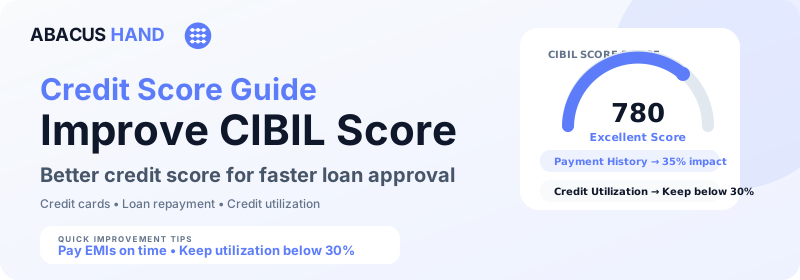
Payment history accounts for 35% of your CIBIL score — making it the single most important factor. Even one missed payment can drop your score by 50-100 points. Set up auto-debit for all EMIs and at least the minimum due on credit cards. If you've missed a payment, get current immediately — the longer a payment remains overdue, the more damage it causes. A 90-day late payment is far worse than a 30-day delay. Estimate the maximum loan amount you can qualify for using our free loan eligibility calculator.
Set up payment reminders 5 days before due dates. Even if you have auto-debit, ensure sufficient balance in your account to avoid bounce charges, which also negatively impact your score.
2. Keep Credit Utilization Below 30%
Credit utilization ratio — the percentage of your available credit limit that you're using — is the second most important factor (30% weightage). If your credit card limit is ₹3 lakh, try to keep your outstanding balance below ₹90,000 at any point. Ideally, keep it under 20% for the best impact. If you regularly max out your cards, request a credit limit increase or spread expenses across multiple cards.
3. Don't Close Old Credit Cards
The length of your credit history matters. Your oldest credit account shows lenders you have experience managing credit. Closing an old card reduces your average account age and total available credit limit (increasing utilization ratio). Even if you don't use an old card regularly, keep it active with a small recurring charge like a streaming subscription. The annual fee is worth the credit history benefit.
4. Limit Hard Inquiries
Every time you apply for a loan or credit card, the lender makes a 'hard inquiry' on your credit report. Each inquiry can reduce your score by 5-10 points. Multiple inquiries in a short period signal desperation to lenders. Space out your credit applications by at least 3-6 months. When shopping for loan rates, try to complete all applications within a 30-day window — CIBIL treats multiple inquiries for the same loan type within this period as a single inquiry.
5. Maintain a Healthy Credit Mix
CIBIL rewards borrowers who can manage different types of credit responsibly. A mix of secured loans (home loan, car loan) and unsecured credit (credit cards, personal loans) shows versatility. If you only have credit cards, consider a small personal loan or vice versa. However, don't take unnecessary debt just for credit mix — only borrow what you genuinely need. Check your potential monthly outflows using our personal loan calculator.
6. Check Your Credit Report for Errors
Errors in credit reports are more common than you think. Wrong account details, payments marked as late when they weren't, duplicate accounts, or someone else's loan appearing on your report can drag your score down unfairly. You're entitled to one free CIBIL report per year. Review it carefully and dispute any errors through CIBIL's online portal. Corrections typically take 30-45 days and can boost your score significantly.
Common errors to look for in your CIBIL report:
- Loans you never took (possible identity theft)
- Closed accounts still showing as open
- Incorrect payment status (showing late when paid on time)
- Wrong credit limit reported (inflating utilization)
- Duplicate entries for the same account
- Settled accounts not updated after full payment
7. Become an Authorized User
If you have limited credit history, ask a family member with excellent credit to add you as an authorized user on their credit card. Their positive payment history and low utilization will reflect on your report, giving your score a boost. This is particularly useful for young professionals just starting their credit journey. Ensure the primary cardholder maintains good habits, as their negative behavior will also affect your score.
8. Settle Outstanding Dues Strategically
If you have overdue accounts, prioritize paying them off. However, avoid 'settling' loans for less than the full amount — settled accounts are marked as 'Settled' rather than 'Closed' on your report, which is a red flag for future lenders. Always try to pay the full outstanding amount. If you must settle, negotiate with the lender to report it as 'Closed' rather than 'Settled' — get this in writing before making payment.
A 'Settled' status on your CIBIL report stays for 7 years and can reduce your score by 75-100 points. Always prefer full payment over settlement, even if it takes longer.
9. Use a Secured Credit Card to Rebuild
If your score is below 600 and you can't get a regular credit card, apply for a secured credit card. Banks like SBI, ICICI, and Axis offer secured cards against a fixed deposit. Your FD amount becomes your credit limit. Use this card for small purchases (under 30% of limit) and pay the full bill every month. Within 6-12 months of responsible use, your score should improve enough to qualify for regular credit products.
10. Avoid Being a Loan Guarantor Carelessly
When you guarantee someone's loan, it appears on your credit report as a contingent liability. If the borrower defaults, you become responsible for repayment, and the default impacts your CIBIL score. Only guarantee loans for people you trust completely, and monitor the loan's repayment status regularly. Many people have seen their scores destroyed because a friend or relative defaulted on a guaranteed loan.
How Long Does It Take to Improve CIBIL Score?
Improving your CIBIL score is not instant — it requires consistent effort over time. Minor improvements (20-50 points) from reducing utilization can show within 1-2 months. Recovering from missed payments takes 6-12 months of on-time payments. Rebuilding from a very low score (below 550) to 750+ typically takes 12-24 months of disciplined credit behavior. The key is patience and consistency.
Impact of CIBIL Score on Loan Interest Rates
The difference between a 650 and 780 CIBIL score can mean 1.5-3% higher interest rate on loans. On a ₹50 lakh home loan for 20 years, a 1.5% higher rate means paying ₹18+ lakh more in interest over the loan tenure. For personal loans, the difference is even starker — rates can vary from 10.5% (excellent score) to 18-24% (poor score). Investing time in improving your score literally pays for itself many times over.
Check how your credit score affects your loan eligibility
Use Loan Eligibility CalculatorFrequently Asked Questions
With consistent effort — paying all bills on time, reducing credit utilization below 30%, and fixing report errors — you can improve from 600 to 750 in approximately 9-18 months. Quick wins like correcting errors or reducing utilization can show results in 1-2 months.
No. Checking your own score is a 'soft inquiry' and does not affect your CIBIL score. You can check it as often as you like. Only 'hard inquiries' made by lenders when you apply for credit affect your score.
Yes, some banks and NBFCs approve home loans at 650, but you'll likely pay 0.5-1.5% higher interest rate compared to someone with 750+. On a ₹50 lakh loan, this means ₹6-18 lakh extra interest over 20 years. It's worth improving your score before applying if possible.
Closing a loan after full repayment is positive for your score as it shows responsible credit behavior. However, if it was your only installment loan, it reduces your credit mix diversity. The net effect is usually positive, especially if the loan had a clean repayment history.