Data last verified: June 2026
Should You Prepay Your Loan or Invest? A Practical Guide
The classic dilemma — prepay your home or personal loan or invest in mutual funds/stocks? This guide helps you decide with real numbers, after-tax comparison, and a practical framework for Indian borrowers.
Ranveer Patel is a finance professional and founder of AbacusHand. She specialises in EMI & loan planning, income tax under old and new regimes, and SIP investment analysis for Indian households. Every calculator and article on AbacusHand is personally reviewed by her for accuracy.
You've got some extra cash — maybe a bonus, maybe savings that have piled up. And now you're staring at two options: throw it at your loan and sleep better at night, or invest it and let compounding work its magic. I get asked this question more than any other personal finance question, and the honest answer is — it depends on the type of loan, the interest rate, and your personal comfort with debt.
Let me help you think through this clearly. No generic advice, just a framework with real numbers that works for most Indian borrowers in 2026.
This article is for educational purposes and does not constitute financial advice. Investment returns are not guaranteed and past performance does not indicate future results. Consult a SEBI-registered financial advisor for personalized advice based on your specific situation.
The Core Framework: Compare After-Tax Costs
The decision comes down to one simple comparison: Is the effective cost of your loan (after tax benefits) higher or lower than the expected after-tax return from investing that money?
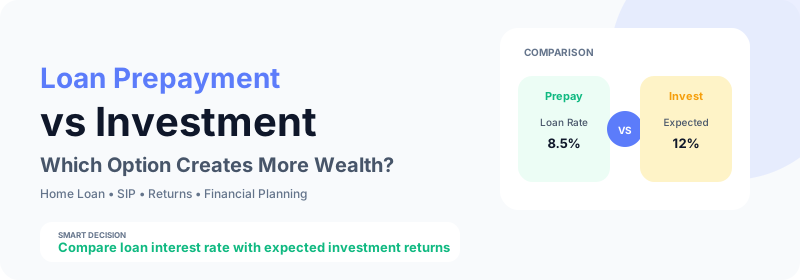
If your loan costs you 8.5% but your investments can earn 12% after tax — you invest. If your loan costs you 12% and your investments might earn 10-11% after tax — you prepay. The tricky part is calculating the 'effective' rate for both sides honestly.
The comparison framework:
- Step 1: Find your loan's effective interest rate after considering tax deductions
- Step 2: Estimate your realistic investment returns (not best-case scenario)
- Step 3: Subtract tax on investment gains (LTCG, STCG, or income tax)
- Step 4: Compare the two numbers — the higher effective rate wins
- Step 5: Factor in your personal risk tolerance and peace of mind
When Prepayment Clearly Wins
There are situations where prepaying your loan is almost always the better choice, no matter what the stock market is doing:
Prepay your loan when:
- Personal loan at 12-18% — no investment reliably beats this rate after tax
- Credit card debt at 24-42% — this is an emergency, prepay immediately
- Car loan at 9-12% — no tax benefit, and cars depreciate so no asset backing
- Home loan if you've already claimed ₹2 lakh limit under Section 24(b) and ₹1.5 lakh under 80C
- You're in the first 3-5 years of a home loan (when interest component is highest in EMI)
- Your risk tolerance is low and loan stress affects your sleep or mental health
Let me put numbers to this. If Rajesh has a ₹5 lakh personal loan at 14% interest, prepaying ₹1 lakh saves him approximately ₹14,000 per year in guaranteed interest. To beat this by investing, he'd need a post-tax return above 14% — which essentially means taking very high equity risk. The math is clear: prepay the personal loan.
When Investing Clearly Wins
On the flip side, there are scenarios where keeping the loan and investing makes more financial sense:
Invest instead of prepaying when:
- Home loan at 8-8.5% with full Section 24(b) benefit — effective cost drops to 5.5-6%
- You have a long investment horizon (7+ years) and can stomach equity volatility
- Your employer offers EPF/VPF at 8.25% — guaranteed return higher than some loan costs
- You haven't maxed out tax-saving investments (80C, NPS 80CCD) that give immediate returns
- You're young (under 35) with no dependents and high risk capacity
- Your loan interest rate is below 8% (some subsidized loans)
Here's the math for a home loan scenario. Meera has a home loan at 8.5% interest. She's in the 30% tax bracket and claims the full ₹2 lakh deduction under Section 24(b). Her effective loan cost becomes approximately 5.9% (8.5% × (1 - 0.312)). If she invests in an index fund earning 12% and holds for 5+ years, her after-tax return (considering 12.5% LTCG above ₹1.25 lakh) is approximately 10.5-11%. Investing wins by a wide margin.
Home Loan vs Personal Loan: Different Strategies
This is crucial — don't apply the same strategy to all loans. Home loans and personal loans need completely different approaches.
Home loans come with tax benefits (Section 24b for interest up to ₹2 lakh, Section 80C for principal up to ₹1.5 lakh). A home loan at 8.5% might effectively cost you only 5.5-6% after tax benefits. Plus, the underlying asset (your home) typically appreciates. There's less urgency to prepay unless you've crossed the tax deduction limits.
Personal loans, car loans, and consumer loans have zero tax benefits and higher interest rates (10-18%). Every rupee of interest is pure cost with no offset. These should always be your prepayment priority before you even think about investing extra money.
Pro tip: If you have multiple loans, prepay in this order — credit card > personal loan > car loan > education loan > home loan. This is the 'avalanche method' — attack the highest-cost debt first.
The Psychological Benefit of Being Debt-Free
Here's something spreadsheets don't capture: the mental peace of being debt-free. I've spoken with enough people to know that for many, a loan hanging over their head affects their career decisions, their willingness to take risks, and their overall happiness.
If you're someone who checks your loan outstanding balance every week, who feels anxious about job security because of EMI obligations, or who can't enjoy spending money because 'the loan is still there' — the psychological return of prepaying may be worth more than the 2-3% extra return investing might give you. You can use our free EMI calculator to instantly verify these calculations.
That said, don't let fear of debt make you ignore basic financial planning. An emergency fund and health insurance should come before aggressive prepayment. Being debt-free but with zero savings is a fragile position.
The Hybrid Strategy: Do Both
For most people, the best answer isn't purely one or the other. Here's a balanced approach that I think works well:
The 50-30-20 surplus allocation:
- 50% of surplus toward investments (SIP in equity mutual funds for long-term goals)
- 30% toward loan prepayment (reducing principal and interest burden)
- 20% toward emergency fund or short-term goals (until you have 6 months' expenses saved)
- Once emergency fund is full, shift that 20% to prepayment or investments based on loan rate
- Review this split annually — as your loan reduces, shift more toward investments
Example: Deepak gets a ₹1.2 lakh annual bonus. Under this approach, he'd invest ₹60,000 (SIP in Nifty 50 index fund), prepay ₹36,000 on his home loan, and add ₹24,000 to his emergency fund. He's building wealth, reducing debt, AND creating a safety net — all at once. You can estimate your investment growth using our free SIP calculator.
Real Example: The Numbers Behind the Decision
Let's work through a complete example to make this concrete.
Scenario: Sneha has a home loan of ₹40 lakh at 8.5% with 18 years remaining. She has ₹5 lakh surplus to either prepay or invest.
Option A — Prepay ₹5 lakh on home loan:
- Interest saved over remaining tenure: approximately ₹7.8 lakh
- Loan tenure reduces by about 2 years
- Effective guaranteed return: 8.5% (or ~5.9% after Section 24b benefit)
- Zero risk — this is a guaranteed savings
Option B — Invest ₹5 lakh in equity mutual fund (SIP over 12 months):
- Expected value after 18 years at 12% CAGR: approximately ₹38.5 lakh
- After LTCG tax (12.5% on gains above ₹1.25 lakh): approximately ₹34.3 lakh
- Net gain: approximately ₹29.3 lakh
- But this comes with market risk — actual returns could be 8% or 15%
For Sneha, investing wins on expected returns by a large margin (₹29 lakh potential gain vs ₹7.8 lakh interest saved). But she needs to be comfortable with equity volatility over 18 years. If she'll panic-sell during a crash, prepayment is safer. My suggestion for her: invest ₹3.5 lakh and prepay ₹1.5 lakh.
Quick Decision Checklist
Use this to make your decision:
- Loan rate above 12%? → Prepay first, no question
- Loan rate below 8% with tax benefits? → Invest, especially if horizon is 7+ years
- Loan rate 8-12% without tax benefits? → Prepay unless you're very disciplined with equity
- No emergency fund yet? → Build that first before either option
- Less than 5 years to retirement? → Prepay for peace of mind
- Under 35 with stable job? → Lean toward investing for long-term compounding
- Emotionally stressed about debt? → Prepay — mental health has real value
There's no universally right answer here. What matters is that you're intentional about the decision rather than leaving surplus cash idle in your savings account earning 3-4%. Both prepaying and investing are better than doing nothing.
Compare how different prepayment amounts affect your total loan cost, or calculate potential SIP returns over the same period.
Use EMI CalculatorFrequently Asked Questions
It depends on your effective loan cost after tax benefits. If your home loan rate is 8.5% and you claim Section 24(b) deduction, your effective cost is around 5.9%. Since equity mutual funds have historically delivered 10-12% over long periods, investing generally makes more mathematical sense. However, if you're risk-averse or close to retirement, prepaying gives guaranteed debt-free peace of mind.
Almost always prepay the personal loan first. Personal loans carry 12-18% interest with zero tax benefits. No investment reliably delivers 12-18% after-tax returns consistently. Once your personal loan is cleared, redirect those funds into a SIP for long-term wealth creation.
Multiply your home loan interest rate by (1 - your tax rate including cess). For example, if your rate is 8.5% and you're in the 30% bracket (31.2% with cess), effective cost = 8.5% × (1 - 0.312) = approximately 5.85%. This only applies if your annual interest is below ₹2 lakh (Section 24b limit for self-occupied property).
Yes, even small prepayments make a meaningful difference early in your loan tenure. Prepaying just ₹5,000 extra per month on a ₹30 lakh home loan at 8.5% can reduce your tenure by 4-5 years and save ₹8-10 lakh in total interest. The key is consistency — small amounts compound significantly over time.
Compare after-tax FD returns with your loan rate. If your FD earns 7% and you're in the 30% bracket, your after-tax FD return is only about 4.8%. If your loan rate is 8.5% or higher, breaking the FD and prepaying saves you money. The exception is if the FD is your emergency fund — never break that for prepayment.