Data last verified: May 2026
HRA Calculation Formula (2026) – Section 10(13A) Tax Rules
Calculate HRA tax exemption using Section 10(13A) rules. Step-by-step 50%/40% metro salary formula with real examples to maximize rent tax savings.
Ranveer Patel is a finance professional and founder of AbacusHand. She specialises in EMI & loan planning, income tax under old and new regimes, and SIP investment analysis for Indian households. Every calculator and article on AbacusHand is personally reviewed by her for accuracy.
House Rent Allowance (HRA) is one of the most significant tax-saving components in a salaried person's salary structure. If you live in a rented accommodation, you can claim HRA exemption under Section 10(13A) of the Income Tax Act. For someone paying ₹25,000/month rent in a metro city, the HRA exemption can save ₹30,000-60,000 in taxes annually. Understanding the HRA calculation formula helps you maximize this benefit.
What is HRA (House Rent Allowance)?
HRA is a component of your salary that your employer pays to help cover your rental expenses. It's part of your CTC (Cost to Company) and appears on your salary slip. While HRA is fully taxable as income, you can claim an exemption on a portion of it if you actually pay rent for your accommodation. The exemption amount is calculated using a specific formula defined by the Income Tax Act. Compare your tax liability under the new vs old regimes using our income tax calculator. Calculate your monthly take-home pay and tax deductions using our salary calculator.
HRA exemption is available only under the Old Tax Regime. If you've opted for the New Tax Regime, HRA received is fully taxable regardless of rent paid.
HRA Calculation Formula
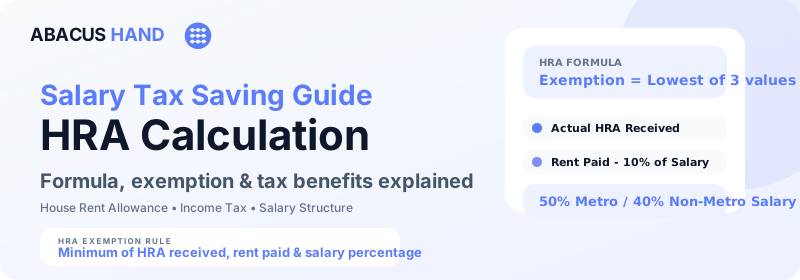
Under Section 10(13A) of the Income Tax Act, the exempt portion of your House Rent Allowance is the LEAST of the following three calculations:
HRA exemption = Minimum of:
- 1. Actual HRA received from your employer during the financial year
- 2. 50% of Basic Salary (for metro cities: Delhi, Mumbai, Chennai, Kolkata) OR 40% of Basic Salary (for all non-metro cities)
- 3. Total rent paid minus 10% of Basic Salary
The 50% vs 40% of Basic Salary Rule Explained
Under Indian tax law, the 50% vs 40% rule is strictly based on the geographic location of your rented accommodation, not where your company office is registered. Only 4 cities qualify for 50% of basic salary: New Delhi, Mumbai, Kolkata, and Chennai. All other major IT hubs—including Bangalore, Hyderabad, Pune, Gurgaon, and Noida—are legally classified as non-metro (40% of basic salary) for HRA computation.
The key term here is 'basic salary' which includes Basic Pay + Dearness Allowance (DA) if DA forms part of retirement benefits. Commission received as a fixed percentage of turnover is also included.
HRA Calculation Example: Metro City
Let's calculate HRA exemption for Rahul who works in Mumbai with the following salary structure:
Rahul's salary details:
- Basic Salary: ₹50,000/month (₹6,00,000/year)
- HRA received: ₹25,000/month (₹3,00,000/year)
- Rent paid: ₹22,000/month (₹2,64,000/year)
- City: Mumbai (metro)
Calculating the three components:
- Actual HRA received: ₹3,00,000
- 50% of basic salary (metro): 50% × ₹6,00,000 = ₹3,00,000
- Rent paid - 10% of basic: ₹2,64,000 - ₹60,000 = ₹2,04,000
HRA exemption = Minimum of (₹3,00,000, ₹3,00,000, ₹2,04,000) = ₹2,04,000. So Rahul can claim ₹2,04,000 as HRA exemption. The remaining ₹96,000 (₹3,00,000 - ₹2,04,000) is taxable.
HRA Calculation Example: Non-Metro City
Now let's calculate for Priya who works in Pune (non-metro):
Priya's salary details:
- Basic Salary: ₹40,000/month (₹4,80,000/year)
- HRA received: ₹16,000/month (₹1,92,000/year)
- Rent paid: ₹15,000/month (₹1,80,000/year)
- City: Pune (non-metro)
Calculating the three components:
- Actual HRA received: ₹1,92,000
- 40% of basic salary (non-metro): 40% × ₹4,80,000 = ₹1,92,000
- Rent paid - 10% of basic: ₹1,80,000 - ₹48,000 = ₹1,32,000
HRA exemption = Minimum of (₹1,92,000, ₹1,92,000, ₹1,32,000) = ₹1,32,000. Priya can claim ₹1,32,000 as exempt. The remaining ₹60,000 is added to her taxable income.
How to Maximize Your HRA Exemption
Tips to get maximum HRA benefit:
- Restructure salary to increase basic pay (higher basic = higher HRA limit)
- If rent exceeds ₹1 lakh/month, get landlord's PAN for tax compliance
- Pay rent to parents if they own the house — they declare rental income, you claim HRA
- Keep rent receipts and rental agreement as proof
- For rent above ₹8,333/month, landlord's PAN is mandatory in Form 12BB
- Consider sharing rent agreement with spouse to optimize both HRA claims
You can pay rent to your parents and claim HRA exemption, provided they declare the rental income in their ITR. This is a legitimate tax-saving strategy approved by multiple ITAT rulings.
Documents Required for HRA Claim
Keep these documents ready for HRA exemption:
- Rent receipts (monthly or quarterly) with revenue stamp for cash payments
- Rental agreement (registered or unregistered)
- Landlord's PAN card copy (mandatory if annual rent exceeds ₹1,00,000)
- Bank statements showing rent transfer (for digital payments)
- Form 12BB declaration submitted to employer
HRA When You Live in Your Own House
If you live in your own house and don't pay rent, you cannot claim HRA exemption. The HRA received becomes fully taxable. However, if you have a home loan, you can claim interest deduction under Section 24(b) up to ₹2 lakh and principal repayment under Section 80C. Some people who own a house in one city but work in another city can claim both HRA (for rented accommodation in work city) and home loan benefits (for owned house in another city).
Section 80GG: HRA Alternative for Self-Employed
If you don't receive HRA from your employer (self-employed, freelancers, or employees without HRA component), you can claim deduction under Section 80GG. The deduction is the minimum of:
Section 80GG deduction = Minimum of:
- ₹5,000 per month (₹60,000 per year)
- 25% of total income (after other deductions)
- Actual rent paid minus 10% of total income
To claim 80GG, you must file Form 10BA declaring that you don't own any residential property at the place of employment. The maximum benefit under 80GG is limited to ₹60,000/year, which is significantly lower than HRA exemption for most salaried individuals.
HRA Exemption for Different Salary Levels
Approximate HRA tax savings at different salary levels (metro city, 30% bracket):
- Basic ₹30,000/month, Rent ₹15,000: Exemption ~₹1,44,000, Tax saved ~₹44,928
- Basic ₹50,000/month, Rent ₹25,000: Exemption ~₹2,40,000, Tax saved ~₹74,880
- Basic ₹75,000/month, Rent ₹35,000: Exemption ~₹3,30,000, Tax saved ~₹1,02,960
- Basic ₹1,00,000/month, Rent ₹45,000: Exemption ~₹4,20,000, Tax saved ~₹1,31,040
Common HRA Mistakes to Avoid
Avoid these errors when claiming HRA:
- Claiming HRA without actually paying rent (tax fraud — attracts penalty)
- Not collecting rent receipts throughout the year
- Forgetting to provide landlord's PAN for rent above ₹1 lakh/year
- Claiming HRA in New Tax Regime (not allowed)
- Not declaring HRA exemption while filing ITR (even if employer already adjusted)
- Using fake rent receipts — IT department cross-verifies with landlord's ITR
The Income Tax Department uses data analytics to identify fake HRA claims. They cross-reference your rent receipts with your landlord's ITR. Always ensure genuine transactions.
Calculate your exact HRA exemption instantly with our free tool
Use HRA CalculatorCalculate your exact in-hand salary including HRA benefits
Use Salary CalculatorFrequently Asked Questions
HRA exemption is the minimum of three amounts: (1) Actual HRA received, (2) 50% of basic salary for metro cities or 40% for non-metro cities, and (3) Actual rent paid minus 10% of basic salary. The lowest of these three is your exempt HRA.
Yes, you can pay rent to your parents and claim HRA exemption. Your parents must declare this rental income in their ITR. Keep a proper rental agreement and make payments through bank transfer for documentation. This is a legitimate tax-saving strategy.
No, HRA exemption under Section 10(13A) is not available in the New Tax Regime. If you opt for the new regime, the entire HRA received is taxable. You only get a standard deduction of ₹75,000 in the new regime.
If your actual rent exceeds HRA received, the exemption is still limited to the minimum of the three formula components. The excess rent paid doesn't provide additional tax benefit under HRA, but you may claim Section 80GG if applicable.