Data last verified: May 2026
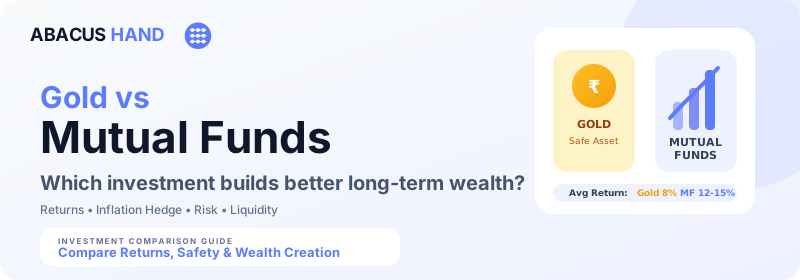
Gold vs Mutual Funds: Where Should You Invest?
Compare gold and mutual fund investments across returns, risk, liquidity, and tax efficiency. Find out which suits your portfolio better in the Indian context.
Ranveer Patel is a finance professional and founder of AbacusHand. She specialises in EMI & loan planning, income tax under old and new regimes, and SIP investment analysis for Indian households. Every calculator and article on AbacusHand is personally reviewed by her for accuracy.
Gold and mutual funds represent two fundamentally different investment philosophies. Gold is a traditional store of value that Indians have trusted for centuries, while mutual funds offer market-linked growth through professional management. With gold prices crossing ₹70,000 per 10 grams in 2025 and equity markets at all-time highs, the question of where to invest has become more relevant than ever. Let's compare both options objectively.
Historical Returns: Gold vs Equity Mutual Funds
Over the last 20 years (2005-2025), gold in India has delivered approximately 11-12% CAGR, rising from about ₹6,000 per 10 grams to over ₹70,000. During the same period, the Nifty 50 index delivered approximately 13-14% CAGR. However, these averages hide important patterns — gold tends to outperform during economic uncertainty, while equities shine during growth periods. Evaluate your gold investment returns and potential value using our gold investment calculator. You can estimate your investment growth using our free SIP calculator.
Returns comparison over different periods:
- Last 5 years (2020-2025): Gold ~13% CAGR | Nifty 50 ~14% CAGR
- Last 10 years (2015-2025): Gold ~10% CAGR | Nifty 50 ~12.5% CAGR
- Last 20 years (2005-2025): Gold ~11.5% CAGR | Nifty 50 ~13.5% CAGR
- During 2008 crisis: Gold +25% | Nifty 50 -52%
- During 2020 COVID crash: Gold +28% | Nifty 50 -38% (recovered to +15% by year-end)
- During 2013-2018 (stable economy): Gold -1% CAGR | Nifty 50 +12% CAGR
Ways to Invest in Gold in India
Modern gold investment options:
- Physical Gold: Jewellery, coins, bars — has making charges (8-25%) and storage concerns
- Sovereign Gold Bonds (SGBs): Government-backed, 2.5% annual interest + gold price appreciation, 8-year tenure
- Gold ETFs: Trade on stock exchange, track gold prices, expense ratio 0.5-1%
- Gold Mutual Funds: Fund of funds investing in Gold ETFs, no demat needed, SIP available
- Digital Gold: Buy from ₹1 on apps like PhonePe, Paytm — stored in vaults
Types of Mutual Funds for Comparison
Mutual fund categories and typical returns:
- Large-cap equity funds: 10-12% CAGR (lower risk among equity)
- Mid-cap equity funds: 13-16% CAGR (moderate-high risk)
- Small-cap equity funds: 15-20% CAGR (high risk, high reward)
- Hybrid/Balanced funds: 9-12% CAGR (moderate risk)
- Debt mutual funds: 7-9% CAGR (low risk)
- Index funds (Nifty 50): 12-13% CAGR (market returns at low cost)
Risk Comparison
Gold is often considered a 'safe haven' asset, but it's not risk-free. Gold prices can remain flat or decline for extended periods — between 2013 and 2018, gold gave near-zero returns in India. However, gold rarely crashes dramatically and tends to rise during economic crises, making it an excellent portfolio diversifier. Equity mutual funds carry higher short-term risk but have historically delivered positive returns over any 7+ year period in India.
Gold and equity often move in opposite directions during crises. This negative correlation makes gold an excellent hedge — allocating 10-15% of your portfolio to gold can reduce overall portfolio volatility significantly.
Tax Treatment
Tax comparison (as per FY2025-26 rules):
- Physical Gold (held <3 years): Short-term gains taxed at income tax slab rate
- Physical Gold (held >3 years): 20% LTCG with indexation benefit
- Sovereign Gold Bonds (held till maturity): Completely tax-free capital gains
- Gold ETFs/Mutual Funds: Same as physical gold taxation
- Equity Mutual Funds (held >1 year): 10% LTCG on gains above ₹1 lakh
- Equity Mutual Funds (held <1 year): 15% STCG
- SGB additional benefit: 2.5% annual interest (taxable at slab rate)
Liquidity Comparison
Equity mutual funds offer superior liquidity — you can redeem and get money in your bank account within 1-3 business days. Gold ETFs can be sold instantly during market hours. Physical gold requires finding a buyer and may involve purity verification. Sovereign Gold Bonds have an 8-year lock-in (with exit option after 5 years on interest payment dates). Gold mutual funds can be redeemed in 2-3 business days, similar to equity funds.
Sovereign Gold Bonds: The Best Way to Own Gold
If you want gold exposure, Sovereign Gold Bonds (SGBs) issued by RBI are arguably the best option. You get gold price appreciation plus 2.5% annual interest, and if held till maturity (8 years), capital gains are completely tax-free. There are no storage costs, no risk of theft, and no making charges. The only downside is the 8-year lock-in (5 years for early exit). SGBs are issued in tranches by RBI and can also be bought on stock exchanges.
How Much Gold Should Be in Your Portfolio?
Most financial advisors recommend keeping 10-15% of your investment portfolio in gold. This allocation provides diversification benefits without significantly dragging down returns. For a portfolio of ₹50 lakh, this means ₹5-7.5 lakh in gold (preferably through SGBs or Gold ETFs). The remaining 85-90% should be in equity mutual funds (for growth) and debt instruments (for stability) based on your age and risk profile.
Recommended portfolio allocation by age:
- Age 25-35: 70% equity MF + 15% debt + 10% gold + 5% cash
- Age 35-45: 60% equity MF + 20% debt + 15% gold + 5% cash
- Age 45-55: 45% equity MF + 30% debt + 15% gold + 10% cash
- Age 55+: 30% equity MF + 40% debt + 15% gold + 15% cash
When Gold Outperforms Mutual Funds
Gold tends to outperform during:
- Global economic recessions and financial crises
- High inflation periods (gold is an inflation hedge)
- Geopolitical tensions and wars
- Currency depreciation (rupee weakening boosts gold in INR terms)
- Stock market bear phases lasting 2+ years
When Mutual Funds Outperform Gold
Equity mutual funds tend to outperform during:
- Economic growth and expansion periods
- Low inflation environments
- Bull markets driven by corporate earnings growth
- Periods of political stability and reform
- When interest rates are falling (boosts stock valuations)
Don't count your gold jewellery as an investment. Making charges (8-25%), impurity risks, and emotional attachment make jewellery a poor investment vehicle. Keep jewellery separate from your investment gold allocation.
Calculate how your gold investment will grow over time with our dedicated calculator
Use Gold Investment CalculatorFrequently Asked Questions
Neither is universally better. Gold provides stability and crisis protection (11-12% CAGR over 20 years), while equity mutual funds offer higher growth potential (13-15% CAGR). The best approach is to have both — 10-15% in gold and the rest in mutual funds based on your risk profile.
Sovereign Gold Bonds (SGBs) are the best option — you get gold price appreciation, 2.5% annual interest, and tax-free gains at maturity. For more liquidity, Gold ETFs or Gold mutual funds are good alternatives. Avoid physical gold for investment purposes due to making charges and storage issues.
Financial advisors recommend 10-15% of your investment portfolio in gold for diversification. This provides a hedge against market crashes and inflation without significantly reducing your overall returns.
Yes, you can do SIP in Gold Mutual Funds (like SBI Gold Fund, HDFC Gold Fund) starting from ₹500/month. You can also buy digital gold in small amounts regularly. However, SGBs don't offer SIP — they're issued in tranches by RBI.