Data last verified: May 2026
What is NAV in Mutual Funds? Simple Explanation
Understand what NAV means in mutual funds, how it's calculated daily, and why a high or low NAV doesn't determine if a fund is expensive or cheap.
Ranveer Patel is a finance professional and founder of AbacusHand. She specialises in EMI & loan planning, income tax under old and new regimes, and SIP investment analysis for Indian households. Every calculator and article on AbacusHand is personally reviewed by her for accuracy.
NAV (Net Asset Value) is one of the most commonly used terms in mutual fund investing, yet it's also one of the most misunderstood. Many new investors avoid funds with a 'high NAV' thinking they're expensive, or rush to buy funds with a 'low NAV' thinking they're getting a bargain. Both assumptions are wrong. Let's understand what NAV really means and how it affects your investments.
What Does NAV Mean?
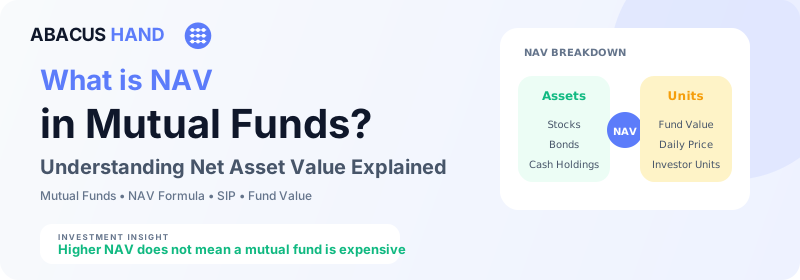
NAV stands for Net Asset Value. It represents the per-unit market value of a mutual fund scheme. Think of it as the 'price' of one unit of the mutual fund. When you invest ₹10,000 in a fund with NAV of ₹50, you get 200 units. If the NAV rises to ₹55, your 200 units are now worth ₹11,000 — a 10% gain. NAV is calculated at the end of every business day by AMFI (Association of Mutual Funds in India) and published by all fund houses. Try our mutual fund return calculator to estimate your potential returns.
How is NAV Calculated?
The formula for NAV is straightforward: NAV = (Total Assets - Total Liabilities) ÷ Total Number of Units Outstanding. Total assets include the market value of all stocks, bonds, and cash held by the fund. Liabilities include management fees, operational expenses, and any pending payments. SEBI mandates that all mutual funds declare their NAV by 9 PM on every business day.
NAV calculation example for a fund with 10 lakh units:
- Market value of stocks held: ₹8 crore
- Bonds and fixed income: ₹1.5 crore
- Cash and equivalents: ₹60 lakh
- Total Assets: ₹10.1 crore
- Total Liabilities (expenses, fees): ₹10 lakh
- Net Assets: ₹10 crore
- NAV = ₹10 crore ÷ 10 lakh units = ₹100 per unit
Why High NAV Doesn't Mean Expensive
This is the biggest misconception about NAV. A fund with NAV of ₹500 is NOT more expensive than a fund with NAV of ₹50. Here's why: If you invest ₹10,000 in Fund A (NAV ₹500), you get 20 units. If you invest ₹10,000 in Fund B (NAV ₹50), you get 200 units. If both funds grow by 10%, Fund A's NAV becomes ₹550 (your value: ₹11,000) and Fund B's NAV becomes ₹55 (your value: ₹11,000). Your return is identical — 10% in both cases.
A high NAV simply means the fund has been around longer or has performed well historically. It says nothing about future returns. Always compare funds based on past performance (CAGR), expense ratio, and fund manager track record — never based on NAV.
NAV and NFO: The ₹10 NAV Trap
New Fund Offers (NFOs) always launch at ₹10 NAV, which attracts many investors who think they're getting units 'cheap.' This is a marketing illusion. A new fund at ₹10 NAV with no track record is actually riskier than an established fund at ₹500 NAV with 10 years of proven performance. The ₹10 NAV gives you more units, but the percentage return is what matters — and that depends on the fund's investment strategy, not its NAV.
How NAV Changes Daily
NAV changes every business day based on the market value of the fund's holdings. If the stocks in an equity fund rise by 1% on a given day, the NAV will also rise by approximately 1% (minus the daily expense ratio). For debt funds, NAV changes are smaller and more stable, typically 0.01-0.05% daily. SEBI requires all fund houses to update NAV by 9 PM every business day, and you can check it on the AMC website or AMFI's portal.
NAV and SIP: How Units Are Allotted
When you invest through SIP, units are allotted based on the NAV on the date your SIP is processed. For example, if your SIP of ₹5,000 is processed on the 5th of each month: In January (NAV ₹100), you get 50 units. In February (NAV ₹95, market dip), you get 52.63 units. In March (NAV ₹105, market rise), you get 47.62 units. This is rupee cost averaging — you automatically buy more units when prices are low. You can estimate your investment growth using our free SIP calculator.
SIP unit allotment example (₹5,000/month):
- Month 1 — NAV ₹100: Units = 50.00
- Month 2 — NAV ₹95: Units = 52.63 (more units at lower price)
- Month 3 — NAV ₹105: Units = 47.62
- Month 4 — NAV ₹90: Units = 55.56 (market crash = more units)
- Month 5 — NAV ₹110: Units = 45.45
- Month 6 — NAV ₹115: Units = 43.48
- Total units after 6 months: 294.74 units at average cost of ₹101.78
NAV Cut-off Timings
SEBI has set specific cut-off times for NAV applicability. For equity and debt funds, if your purchase application (with payment) reaches the fund house before 3:00 PM on a business day, you get that day's NAV. Applications after 3:00 PM get the next business day's NAV. For liquid funds, the cut-off is 1:30 PM for purchases and 3:00 PM for redemptions. This is important for lump-sum investments during volatile markets.
Impact of Expense Ratio on NAV
The expense ratio is deducted from the fund's NAV daily. If a fund has a 1.5% annual expense ratio, approximately 0.004% is deducted from NAV every day. This means if the fund's portfolio grew by 12% in a year, the NAV would reflect only 10.5% growth (12% - 1.5% expense ratio). This is why SEBI has capped expense ratios — currently at 2.25% for equity funds and 2% for debt funds. Direct plans have lower expense ratios (0.5-1%) compared to regular plans (1.5-2.25%).
Impact of expense ratio on ₹10 lakh investment over 20 years (12% gross return):
- Direct plan (0.5% expense): NAV growth 11.5% → Corpus: ₹89.2 lakh
- Regular plan (1.5% expense): NAV growth 10.5% → Corpus: ₹73.7 lakh
- Regular plan (2% expense): NAV growth 10% → Corpus: ₹67.3 lakh
- Difference between direct and regular over 20 years: ₹15.5 lakh on ₹10 lakh invested
NAV vs Share Price: Key Differences
How NAV differs from stock prices:
- NAV is calculated once daily (after market close); stock prices change every second
- NAV reflects actual asset value; stock prices include market sentiment and speculation
- You always buy/sell mutual fund units at NAV; stocks can trade above or below intrinsic value
- NAV cannot be manipulated by traders; stock prices can be influenced by large orders
- Mutual fund units are created/redeemed at NAV; stock supply is fixed
When comparing two funds, never compare their NAVs. Instead, compare their CAGR (returns), expense ratio, Sharpe ratio (risk-adjusted returns), and consistency of performance across market cycles.
Calculate your mutual fund returns based on actual NAV growth and SIP investments
Use Mutual Fund Return CalculatorFrequently Asked Questions
No. A higher NAV simply means the fund has been around longer or has grown more over time. It doesn't indicate future performance. A fund with NAV ₹500 and one with NAV ₹50 can both give the same 12% return. Compare funds based on CAGR, not NAV.
NAV should not be a factor in your investment decision. A low NAV doesn't mean the fund is cheap or a better deal. Focus on the fund's historical returns, expense ratio, fund manager experience, and consistency instead of NAV.
NAV is updated once every business day, after market hours. Fund houses are required by SEBI to declare NAV by 9 PM. On weekends and market holidays, NAV remains unchanged from the previous business day.
NAV represents the actual per-unit value of a fund's assets. Unlike stock prices that fluctuate based on demand/supply during trading hours, NAV is calculated once daily based on the closing prices of all securities held by the fund.