Data last verified: May 2026
What is MCLR and How It Affects Your Loan EMI
Understand MCLR (Marginal Cost of Funds Based Lending Rate), how it differs from EBLR and Base Rate, and its impact on your home loan EMI in India.
Ranveer Patel is a finance professional and founder of AbacusHand. She specialises in EMI & loan planning, income tax under old and new regimes, and SIP investment analysis for Indian households. Every calculator and article on AbacusHand is personally reviewed by her for accuracy.
If you have a home loan or are planning to take one, you've likely encountered terms like MCLR, EBLR, Base Rate, and Repo Rate. These aren't just banking jargon — they directly determine how much EMI you pay every month. Understanding these benchmarks helps you make informed decisions about when to switch rates, whether to transfer your loan, and how RBI policy changes affect your pocket. Let's demystify MCLR and its role in India's lending ecosystem.
What is MCLR?
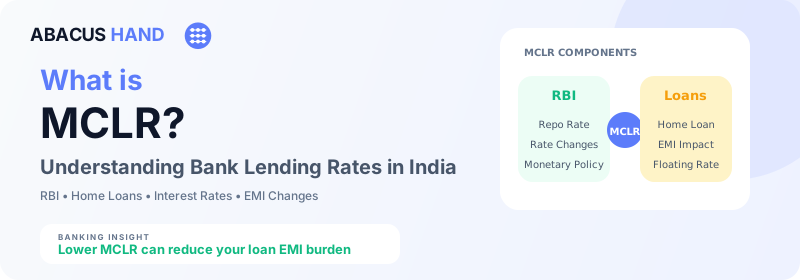
MCLR stands for Marginal Cost of Funds Based Lending Rate. Introduced by RBI in April 2016, it replaced the earlier Base Rate system as the benchmark for floating rate loans. MCLR is the minimum interest rate below which a bank cannot lend (except in certain cases). Your actual loan rate = MCLR + Spread (bank's markup based on your risk profile). For example, if SBI's 1-year MCLR is 8.55% and your spread is 0.10%, your loan rate is 8.65%.
How MCLR is Calculated
Banks calculate MCLR based on four components:
- Marginal Cost of Funds: The cost of new deposits and borrowings (largest component, ~92%)
- Negative Carry on CRR: Cost of maintaining Cash Reserve Ratio with RBI (earns no interest)
- Operating Costs: Administrative expenses of running the bank
- Tenor Premium: Additional cost for longer-term lending (higher for longer MCLR periods)
Banks publish MCLR for different tenors — overnight, 1 month, 3 months, 6 months, 1 year, 2 years, and 3 years. Most home loans are linked to the 6-month or 1-year MCLR. The rate resets periodically (every 6 or 12 months from your loan disbursement date), meaning your EMI changes only at reset dates, not immediately when MCLR changes. You can use our free EMI calculator to instantly verify these calculations.
MCLR vs EBLR (Repo-Linked Rate): Key Differences
Since October 2019, RBI mandated that all new floating rate loans be linked to an External Benchmark Lending Rate (EBLR) — typically the RBI repo rate. This was because MCLR transmission was slow — banks were quick to raise MCLR when rates went up but slow to reduce it when rates fell. EBLR ensures faster and more transparent rate transmission.
MCLR vs EBLR comparison:
- Transparency: EBLR is based on publicly known repo rate; MCLR is internally calculated by each bank
- Rate Transmission: EBLR changes within 3 months of repo rate change; MCLR may take 6-12 months
- Reset Frequency: EBLR resets every 3 months; MCLR resets every 6-12 months
- Borrower Benefit: EBLR passes rate cuts faster; MCLR delays benefits to borrowers
- Current Status: All new loans (post Oct 2019) are on EBLR; older loans may still be on MCLR
- Switching: You can switch from MCLR to EBLR by paying a nominal fee (₹500-5,000)
If your home loan is still on MCLR (taken before October 2019), consider switching to EBLR. When RBI cuts rates in the future, EBLR loans benefit within 3 months while MCLR loans may take 6-12 months to reflect the reduction.
Evolution of Lending Rate Systems in India
How India's lending rate benchmarks have evolved:
- Before 2003: PLR (Prime Lending Rate) — Banks set rates with minimal regulation
- 2003-2010: BPLR (Benchmark PLR) — Slightly more standardized but still opaque
- 2010-2016: Base Rate — RBI mandated minimum lending rate, improved transparency
- 2016-2019: MCLR — Better rate transmission than Base Rate, linked to marginal cost
- 2019-Present: EBLR — External benchmark (repo rate), fastest transmission, most transparent
How RBI Repo Rate Changes Affect Your EMI
The RBI repo rate is the rate at which RBI lends to commercial banks. When RBI increases the repo rate (to control inflation), banks' borrowing costs rise, and they pass this on through higher MCLR/EBLR. During 2022-23, RBI raised the repo rate from 4% to 6.5% (250 basis points increase). This translated to approximately 1.5-2% increase in home loan rates, raising EMI on a ₹50 lakh loan by ₹5,000-7,000 per month. Plan your home buying journey by computing your EMIs with our home loan calculator.
MCLR Reset: When Does Your Rate Change?
If your loan is linked to 1-year MCLR, your rate resets once every 12 months from your loan disbursement/last reset date. This means even if MCLR changes today, your EMI won't change until your next reset date. For example, if your loan was disbursed on March 15, 2025, your rate resets on March 15, 2026, regardless of how many times MCLR changed during the year. This creates a lag in rate transmission — both positive (delays rate hikes) and negative (delays rate cuts).
Should You Switch from MCLR to EBLR?
The decision depends on your current rate and expectations about future rate movements. If you expect RBI to cut rates (inflation is under control, economy needs stimulus), switching to EBLR is beneficial as cuts transmit faster. If rates are expected to rise, staying on MCLR gives you a buffer due to slower transmission. Currently (FY2025-26), with repo rate at 6.5% and expectations of rate cuts in the medium term, switching to EBLR is generally advisable for most borrowers.
When to switch from MCLR to EBLR:
- Your current MCLR-linked rate is higher than available EBLR rate
- RBI is expected to cut rates in the coming 1-2 years
- Your loan has 10+ years remaining (more time to benefit from future cuts)
- The switching fee is nominal (₹500-5,000) compared to potential savings
- You want more frequent rate resets (quarterly vs annual)
Current MCLR Rates of Major Banks (2025-26)
1-Year MCLR rates of major Indian banks (as of FY2025-26):
- State Bank of India (SBI): 8.55%
- HDFC Bank: 9.20%
- ICICI Bank: 8.85%
- Bank of Baroda: 8.60%
- Punjab National Bank: 8.60%
- Canara Bank: 8.55%
- Union Bank of India: 8.55%
- Kotak Mahindra Bank: 9.10%
Impact on Different Loan Types
MCLR affects all floating rate loans, but the impact varies by loan type. Home loans (15-30 year tenure) are most affected because even small rate changes compound over decades. A 0.5% increase on a ₹50 lakh home loan for 20 years adds ₹5.8 lakh to total interest. Car loans (3-7 years) are less impacted due to shorter tenure. Personal loans are often fixed rate, so MCLR changes don't affect existing personal loan borrowers.
What Borrowers Should Do When MCLR Rises
Steps to take when your loan rate increases:
- Increase your EMI voluntarily to maintain original tenure (prevents tenure extension)
- Make a lump-sum prepayment to offset the rate increase impact
- Consider balance transfer if another bank offers significantly lower rate
- Switch from MCLR to EBLR if the EBLR rate is lower
- Review your budget and cut discretionary spending to accommodate higher EMI
- Don't panic — rate cycles are normal, rates will eventually come down
See how interest rate changes affect your loan EMI
Use EMI CalculatorFrequently Asked Questions
MCLR stands for Marginal Cost of Funds Based Lending Rate. It was introduced by RBI in April 2016 as the benchmark for floating rate loans, replacing the earlier Base Rate system. It represents the minimum rate at which banks can lend.
New home loans (post October 2019) are linked to EBLR (External Benchmark Lending Rate), not MCLR. However, millions of older home loans taken before October 2019 are still on MCLR. These borrowers can switch to EBLR by paying a nominal fee to their bank.
Banks review and publish MCLR rates monthly. However, your loan rate only changes at your reset date (every 6 or 12 months depending on your loan agreement). So even if MCLR changes monthly, your EMI changes only at reset intervals.
If you expect RBI to cut rates in the future and your loan has 10+ years remaining, switching to EBLR is generally beneficial. EBLR transmits rate cuts within 3 months vs 6-12 months for MCLR. The switching fee is typically ₹500-5,000 — minimal compared to potential savings.