Data last verified: May 2026
Top 10 Banks with Lowest Home Loan Interest Rates 2025-26
Compare the lowest home loan interest rates from top Indian banks in 2025-26. Find the best rates from SBI, HDFC, ICICI, and more to save lakhs on your EMI.
Ranveer Patel is a finance professional and founder of AbacusHand. She specialises in EMI & loan planning, income tax under old and new regimes, and SIP investment analysis for Indian households. Every calculator and article on AbacusHand is personally reviewed by her for accuracy.
Choosing the right bank for your home loan can save you lakhs — even crores — over the loan tenure. A difference of just 0.25% in interest rate on a ₹50 lakh loan for 20 years translates to savings of approximately ₹3 lakh in total interest. With RBI's repo rate at 6.50% (as of FY2025-26), home loan rates across banks range from 8.25% to 9.75%. Here's a comprehensive comparison of the top banks offering the lowest home loan interest rates in India.
Top 10 Banks with Lowest Home Loan Rates (2025-26)
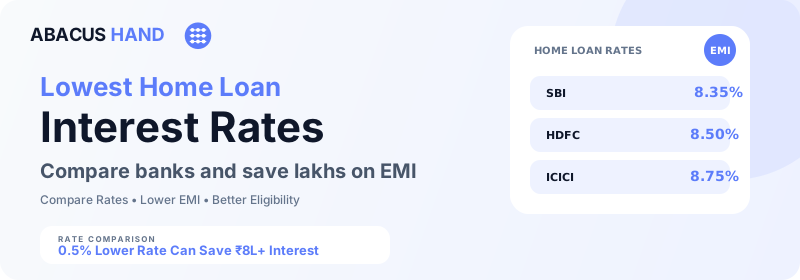
Current home loan interest rates from major Indian banks (rates as of FY2025-26, subject to change):
- Bank of Baroda: 8.25% - 10.60% (among the lowest for salaried individuals)
- State Bank of India (SBI): 8.40% - 9.85% (largest lender, competitive rates)
- LIC Housing Finance: 8.35% - 10.45% (strong for longer tenures)
- Punjab National Bank: 8.40% - 10.25% (competitive for government employees)
- Union Bank of India: 8.35% - 10.50% (good for women borrowers)
- Canara Bank: 8.40% - 10.65% (special rates for premium customers)
- Bank of India: 8.40% - 10.65% (competitive processing fees)
- HDFC Bank: 8.50% - 9.75% (fast processing, premium service)
- ICICI Bank: 8.50% - 9.85% (flexible repayment options)
- Kotak Mahindra Bank: 8.55% - 9.80% (good for high-value loans)
Interest rates vary based on loan amount, CIBIL score, employment type, and property location. The lowest rates are typically offered to salaried individuals with 800+ CIBIL scores borrowing less than ₹30 lakh. Always get a personalized quote.
Factors That Determine Your Home Loan Rate
Banks consider these factors when deciding your interest rate:
- CIBIL Score: 750+ gets the best rates; below 700 adds 0.5-1.5% premium
- Loan Amount: Loans under ₹30 lakh often get lower rates than ₹75 lakh+
- Employment Type: Salaried (especially government) gets better rates than self-employed
- Loan-to-Value Ratio: Lower LTV (higher down payment) means lower risk and better rates
- Property Type: Ready-to-move gets better rates than under-construction
- Existing Relationship: Salary account holders often get 0.05-0.15% discount
- Women Borrowers: Most banks offer 0.05% concession for women applicants
SBI Home Loan: Detailed Analysis
SBI remains India's largest home loan provider with over ₹7 lakh crore in outstanding housing loans. Their rates start at 8.40% for loans up to ₹30 lakh (CIBIL 800+) and go up to 9.85% for higher amounts with lower credit scores. SBI offers zero processing fee promotions periodically, no prepayment charges on floating rate loans, and a maximum tenure of 30 years. Their 'SBI Privilege Home Loan' for government employees offers additional 0.05% concession. Plan your home buying journey by computing your EMIs with our home loan calculator.
HDFC Bank Home Loan: Detailed Analysis
HDFC Bank (post-merger with HDFC Ltd) offers home loans starting at 8.50% with industry-leading processing speed — often disbursing within 48-72 hours for pre-approved customers. Their strength lies in customer service, digital processes, and flexible repayment options including step-up EMI plans. Processing fee is typically 0.5% of loan amount (₹3,000 minimum). They offer special rates for their existing savings account holders and credit card customers. You can use our free EMI calculator to instantly verify these calculations.
How to Get the Lowest Possible Rate
Strategies to negotiate the best home loan interest rate:
- Improve CIBIL score to 780+ before applying (wait 3-6 months if needed)
- Apply at multiple banks simultaneously and use competing offers to negotiate
- Ask for rate match — show a lower offer from another bank
- Time your application during festive seasons (Oct-Dec) when banks offer special rates
- Consider adding a co-applicant with good income to strengthen the application
- Opt for a shorter tenure (15 years vs 20) — some banks offer lower rates
- Make a larger down payment (30%+) to reduce the bank's risk
- Open a salary account with the lending bank 3-6 months before applying
Fixed vs Floating Rate: Which to Choose?
Almost all home loans in India today are floating rate, linked to the bank's EBLR (External Benchmark Lending Rate) which moves with RBI's repo rate. Fixed rate home loans are rare and typically 1-2% higher than floating rates. Given that home loans are long-tenure (15-30 years), floating rates work out cheaper in most scenarios as rates cycle through highs and lows. However, if you believe rates will rise significantly, a fixed rate provides EMI certainty.
Understanding EBLR, MCLR, and Base Rate
Since October 2019, RBI mandated that all new floating rate loans be linked to an external benchmark — typically the repo rate. Your rate = Repo Rate + Bank's Spread. The spread (markup) varies by bank and borrower profile. Older loans may still be on MCLR (Marginal Cost of Funds Based Lending Rate) or even Base Rate. EBLR loans transmit rate changes faster — when RBI cuts rates, your EMI reduces within 3 months. MCLR loans may take 6-12 months to reflect changes.
If your existing home loan is on MCLR or Base Rate, consider switching to EBLR (repo-linked). Most banks charge ₹500-5,000 for this switch. It ensures faster transmission of future rate cuts by RBI.
Processing Fees and Hidden Charges
Beyond interest rate, compare these charges across banks:
- Processing Fee: 0.25-1% of loan amount (₹2,500 to ₹50,000+)
- Legal and Technical Charges: ₹5,000-15,000 for property verification
- Franking/Stamping Charges: Varies by state (0.1-0.5% of loan amount)
- MODT Charges: Mortgage registration fees (state-specific)
- Prepayment Charges: NIL for floating rate (RBI mandate), 2-3% for fixed rate
- Rate Switch Fee: ₹500-5,000 to move from MCLR to EBLR
- Statement/NOC Charges: ₹200-500 per request
EMI Comparison: How Rate Differences Add Up
For a ₹50 lakh home loan over 20 years: At 8.25% — EMI is ₹42,530, total interest ₹52.07 lakh. At 8.50% — EMI is ₹43,391, total interest ₹54.14 lakh. At 8.75% — EMI is ₹44,263, total interest ₹56.23 lakh. At 9.00% — EMI is ₹45,146, total interest ₹58.35 lakh. The difference between 8.25% and 9.00% is ₹2,616/month or ₹6.28 lakh in total interest. This is why shopping for the best rate matters.
Special Home Loan Schemes to Consider
Government and bank schemes offering subsidized rates:
- PMAY (Pradhan Mantri Awas Yojana): Interest subsidy of 3-6.5% for EWS/LIG/MIG categories
- SBI Her Ghar: 0.05% concession for women borrowers
- Bank of Baroda Baroda Home Loan Advantage: Special rates for existing customers
- Defence/Government Employee Schemes: Additional 0.05-0.25% concession at most PSU banks
- Green Home Loans: Some banks offer 0.25% lower rates for energy-efficient homes
Calculate your home loan EMI at different interest rates
Use Home Loan CalculatorFrequently Asked Questions
Bank of Baroda and Union Bank of India currently offer among the lowest rates starting at 8.25-8.35% for salaried individuals with excellent credit scores (800+) and loan amounts up to ₹30 lakh. SBI follows closely at 8.40%. Actual rates depend on your profile.
Yes, banks have flexibility to offer lower rates, especially if you have a strong profile (high CIBIL score, stable income, low LTV). Get quotes from 3-4 banks and use competing offers as leverage. Festive season offers and salary account relationships also help negotiate better rates.
For a ₹50 lakh loan with 15+ years remaining, a 0.25% reduction saves approximately ₹3 lakh in interest. Balance transfer costs (processing fee + legal charges) are typically ₹10,000-30,000. If savings exceed costs significantly, switching is worthwhile. Use our calculator to check exact savings.
For floating rate loans (most common), yes — your rate changes when the bank revises its EBLR/MCLR. This typically happens when RBI changes the repo rate. Banks must pass on rate changes within 3 months for EBLR-linked loans. Fixed rate loans remain unchanged throughout tenure.