Data last verified: May 2026
What is Loan Amortization? Schedule Explained Simply
Understand loan amortization schedules in simple terms. Learn how EMI splits between principal and interest, and why early payments save more money.
Ranveer Patel is a finance professional and founder of AbacusHand. She specialises in EMI & loan planning, income tax under old and new regimes, and SIP investment analysis for Indian households. Every calculator and article on AbacusHand is personally reviewed by her for accuracy.
If you've ever wondered why your home loan balance barely reduces in the first few years despite paying hefty EMIs, the answer lies in loan amortization. Amortization is the process by which your loan is repaid through equal monthly installments (EMIs), where each payment is split between interest and principal — but the split changes dramatically over time. Understanding this concept can help you make smarter decisions about prepayments and save lakhs in interest.
What is Loan Amortization?
Loan amortization is a repayment structure where you pay a fixed EMI every month, but the composition of that EMI changes over the loan tenure. In the early years, a larger portion of your EMI goes towards paying interest, and a smaller portion reduces the principal. As the loan matures, this ratio reverses — more goes towards principal and less towards interest. This is why a ₹50 lakh home loan at 8.5% for 20 years has a total repayment of ₹1.04 crore — you pay ₹54 lakh in interest alone. Plan your home buying journey by computing your EMIs with our home loan calculator.
How an Amortization Schedule Works
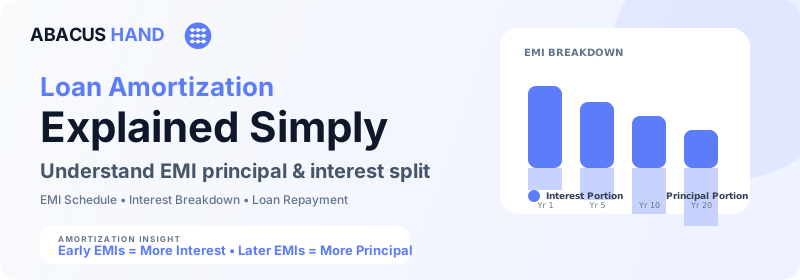
Let's understand with a real example. Consider a home loan of ₹50,00,000 at 8.5% annual interest for 20 years. Your monthly EMI is ₹43,391. In the very first month, the interest component is ₹35,417 (₹50,00,000 × 8.5% ÷ 12) and only ₹7,974 goes towards reducing your principal. By month 120 (year 10), the split becomes roughly equal. By the last year, almost the entire EMI goes towards principal repayment.
EMI breakdown at different stages of a ₹50 lakh loan (8.5%, 20 years, EMI: ₹43,391):
- Month 1: Interest ₹35,417 | Principal ₹7,974 | Balance ₹49,92,026
- Month 60 (Year 5): Interest ₹30,847 | Principal ₹12,544 | Balance ₹43,19,800
- Month 120 (Year 10): Interest ₹24,108 | Principal ₹19,283 | Balance ₹33,97,200
- Month 180 (Year 15): Interest ₹14,267 | Principal ₹29,124 | Balance ₹19,97,600
- Month 240 (Year 20): Interest ₹304 | Principal ₹43,087 | Balance ₹0
In the first 5 years of a 20-year loan, you pay approximately 40% of total interest but reduce only 14% of the principal. This is why prepayments in early years have the maximum impact.
The Amortization Formula
The EMI is calculated using the formula: EMI = P × r × (1+r)^n / [(1+r)^n - 1], where P is the principal loan amount, r is the monthly interest rate (annual rate ÷ 12), and n is the total number of monthly installments. For each month, Interest = Outstanding Balance × Monthly Rate, and Principal = EMI - Interest. The outstanding balance reduces by the principal portion each month.
Why Banks Front-Load Interest
Banks don't deliberately front-load interest to cheat you — it's a mathematical consequence of how interest works. Interest is always calculated on the outstanding balance. Since the balance is highest at the start, interest is naturally highest in early months. As you pay down the principal, the balance reduces, so interest reduces too. This is standard across all amortizing loans worldwide, whether it's SBI, HDFC, or any other lender.
Amortization vs Simple Interest Loans
In a simple interest loan (rare for large loans), interest is calculated only on the original principal throughout the tenure. In an amortizing loan, interest is calculated on the reducing balance. While amortization seems unfavorable initially, it actually results in lower total interest compared to flat-rate (simple interest) loans. A flat rate of 8.5% is equivalent to approximately 15-16% on a reducing balance basis. Always compare loans on reducing balance (amortizing) rates.
How Prepayments Affect the Amortization Schedule
When you make a prepayment, the entire amount goes directly towards reducing the principal. This has a cascading effect — lower principal means lower interest in all subsequent months, which means more of each future EMI goes towards principal. A prepayment of ₹5 lakh in year 3 of our ₹50 lakh loan example can reduce tenure by 3-4 years and save ₹12-15 lakh in interest. The earlier you prepay, the greater the benefit due to the compounding effect.
Reading Your Amortization Schedule
Key columns in an amortization schedule and what they tell you:
- EMI Amount: Your fixed monthly payment (stays constant unless rate changes)
- Principal Component: The portion reducing your loan balance (increases over time)
- Interest Component: The cost of borrowing (decreases over time)
- Outstanding Balance: Remaining loan amount (what you'd need to pay for foreclosure)
- Cumulative Interest: Total interest paid till date (helps assess prepayment benefit)
- Cumulative Principal: Total principal repaid (shows actual loan reduction)
Impact of Interest Rate Changes on Amortization
For floating rate loans (most home loans in India), when RBI increases the repo rate and your bank raises your loan rate, the amortization schedule changes. Banks typically increase your tenure rather than EMI. This means you end up paying significantly more interest over the extended period. For example, when rates rose from 6.5% to 9% during 2022-23, many borrowers saw their 20-year loans extend to 28-30 years. Always ask your bank to increase EMI instead of tenure when rates rise.
When interest rates rise, contact your bank and opt to increase your EMI rather than extend tenure. A ₹50 lakh loan at 9% for 25 years (instead of 20) costs ₹18 lakh more in total interest.
Types of Amortization Schedules
Different amortization structures available in India:
- Standard Amortization: Fixed EMI with changing principal-interest split (most common)
- Step-Up EMI: EMI increases annually (suits young professionals expecting salary growth)
- Step-Down EMI: EMI decreases over time (suits people nearing retirement)
- Bullet Repayment: Only interest paid monthly, principal at end (rare, used in some business loans)
- Balloon Payment: Small EMIs with large final payment (uncommon in India)
Practical Tips for Using Amortization Knowledge
How to use amortization understanding to your advantage:
- Make prepayments in the first 5-7 years for maximum interest savings
- Choose shorter tenure if you can afford higher EMI — total interest drops dramatically
- When rates drop, maintain old EMI amount to reduce tenure
- Request amortization schedule from your bank annually to track progress
- Use free EMI calculator to simulate different prepayment scenarios
Generate your loan amortization schedule with detailed month-by-month breakdown
Use EMI CalculatorFrequently Asked Questions
Because interest is calculated on the outstanding balance, which is highest at the start. In a ₹50 lakh loan at 8.5% for 20 years, about 82% of your first EMI goes towards interest. As the balance reduces over time, more of your EMI goes towards principal repayment.
Always prepay as early as possible. A ₹5 lakh prepayment in year 2 saves approximately ₹15 lakh in interest, while the same prepayment in year 15 saves only ₹2-3 lakh. Early prepayments benefit from the compounding effect over the remaining tenure.
You can request it from your bank (they're required to provide it), download it from your bank's net banking portal, or generate one using an online EMI calculator. The schedule shows month-by-month breakdown of principal, interest, and outstanding balance.
Most retail loans in India (home loans, car loans, personal loans, education loans) follow amortization. Credit cards and overdraft facilities don't follow amortization — they use revolving credit. Business loans may have different structures like bullet repayment.