Data last verified: May 2026
How to Calculate Profit Margin for Your Business
Learn how to calculate gross, operating, and net profit margins with formulas, real business examples, pricing strategies, and industry benchmarks for Indian businesses.
Ranveer Patel is a finance professional and founder of AbacusHand. She specialises in EMI & loan planning, income tax under old and new regimes, and SIP investment analysis for Indian households. Every calculator and article on AbacusHand is personally reviewed by her for accuracy.
Profit margin is one of the most important business metrics because it shows how much money you actually keep from every rupee of sales. Whether you run a retail shop, restaurant, agency, online store, manufacturing business, or startup, understanding profit margins helps you price correctly, control expenses, and grow sustainably. Many businesses generate high revenue but still struggle financially because their margins are too low.
A business with ₹10 lakh revenue and 20% profit margin earns more than a business with ₹25 lakh revenue and 5% margin.
What is Profit Margin?
Profit margin is the percentage of revenue left as profit after deducting expenses. It tells you how efficiently your business converts sales into actual earnings. Quickly calculate your gross, operating, and net margins using our profit margin calculator.
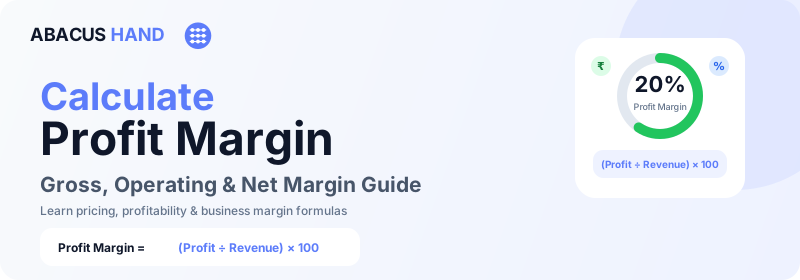
For example, if your business earns ₹1,00,000 in revenue and keeps ₹20,000 as profit, your profit margin is 20%.
Profit Margin = (Profit / Revenue) × 100Calculate your business profit margin instantly
Use Profit Margin CalculatorTypes of Profit Margins
There are three main profit margin types used in business and accounting.
Main types of profit margins:
- Gross Profit Margin — measures product profitability after direct costs
- Operating Profit Margin — measures operational efficiency after business expenses
- Net Profit Margin — measures final profitability after all expenses and taxes
Gross Profit Margin Formula
Gross Profit Margin = ((Revenue - Cost of Goods Sold) / Revenue) × 100Gross margin shows how much money remains after covering direct product or service costs.
Example: A clothing store buys a shirt for ₹400 and sells it for ₹999.
Gross margin calculation example:
- Revenue = ₹999
- Cost of Goods Sold = ₹400
- Gross Profit = ₹599
- Gross Margin = (₹599 ÷ ₹999) × 100 = 59.96%
A higher gross margin gives businesses more flexibility for marketing, salaries, rent, and growth investments.
Operating Profit Margin Formula
Operating Profit Margin = ((Revenue - COGS - Operating Expenses) / Revenue) × 100Operating margin includes daily business expenses like salaries, rent, electricity, software tools, and marketing.
Monthly business example:
- Revenue = ₹5,00,000
- COGS = ₹2,00,000
- Rent = ₹50,000
- Salaries = ₹80,000
- Marketing = ₹20,000
- Utilities & other expenses = ₹25,000
- Operating Profit = ₹1,25,000
- Operating Margin = 25%
Net Profit Margin Formula
Net Profit Margin = ((Revenue - All Expenses) / Revenue) × 100Net margin is the final amount your business actually keeps after all costs including taxes, interest, depreciation, and compliance expenses.
Net profit example:
- Operating Profit = ₹1,25,000
- Loan EMI Interest = ₹15,000
- Taxes = ₹25,000
- Depreciation = ₹5,000
- GST compliance & miscellaneous = ₹5,000
- Net Profit = ₹75,000
- Net Profit Margin = 15%
Profit Margin Example for Small Businesses
Suppose you run a food business with monthly sales of ₹3 lakh and total expenses of ₹2.4 lakh.
Quick example:
- Monthly Revenue = ₹3,00,000
- Total Expenses = ₹2,40,000
- Net Profit = ₹60,000
- Profit Margin = 20%
This means your business keeps ₹20 profit for every ₹100 of sales.
Good Profit Margins by Industry in India
Average net profit margins by industry:
- IT Services: 18–25%
- Restaurants & Cafes: 8–15%
- Retail Shops: 3–8%
- E-commerce Businesses: 1–5%
- Manufacturing: 8–15%
- Pharmaceuticals: 15–20%
- Consulting & Freelancing: 40–70%
- Digital Products & SaaS: 20–40%
Service businesses usually have higher profit margins because they require less inventory and lower operating costs.
Profit Margin vs Markup
Many business owners confuse markup with profit margin, but they are not the same.
Example (Buy at ₹100, Sell at ₹150):
- Profit = ₹50
- Markup = 50%
- Profit Margin = 33.3%
- A 50% markup is NOT equal to 50% margin
Using markup instead of margin often leads to underpricing products and lower profitability.
Common Profit Margin Mistakes
Mistakes businesses commonly make:
- Ignoring hidden costs like delivery, packaging, or transaction fees
- Confusing revenue with profit
- Not accounting for GST correctly
- Using markup instead of margin
- Not tracking monthly margin trends
- Selling low-margin products without understanding profitability
- Offering excessive discounts that destroy margins
How GST Affects Profit Margin
GST does not directly reduce profit margins if your business claims Input Tax Credit (ITC). However, businesses that absorb GST within selling prices may see reduced effective margins. You can easily calculate your net and gross tax amounts using our free GST calculator.
If your product price is ₹1,000 + 18% GST, your revenue for margin calculations is still ₹1,000 because GST collected belongs to the government.
How to Improve Profit Margin
Ways to improve profitability:
- Increase prices strategically
- Negotiate better supplier rates
- Reduce operational waste
- Automate repetitive tasks
- Improve inventory management
- Focus on high-margin products
- Reduce unnecessary subscriptions and expenses
- Increase average order value
Pricing Formula Using Target Margin
Selling Price = Cost / (1 - Target Margin)If your product costs ₹600 and you want a 40% margin:
Example:
- Cost = ₹600
- Target Margin = 40%
- Selling Price = ₹600 ÷ (1 - 0.40)
- Selling Price = ₹1,000
Track Profit Margins Monthly
Tracking profit margins every month helps identify problems early. Declining margins may indicate rising supplier costs, poor pricing, wastage, or inefficient operations.
Even a 2% increase in net margin on ₹50 lakh annual revenue can add ₹1 lakh extra profit annually.
Calculate your exact gross, operating, and net profit margins instantly
Use Profit Margin CalculatorFrequently Asked Questions
A good net profit margin for most small businesses is between 10% and 20%. Retail businesses typically operate at lower margins, while service businesses and SaaS companies often achieve higher margins.
Gross margin measures profit after direct production costs, while net margin measures final profitability after all expenses including salaries, rent, taxes, and interest.
Markup is profit as a percentage of cost price, while margin is profit as a percentage of selling price. A 50% markup equals only a 33.3% margin.
You can improve profit margin by increasing prices strategically, reducing costs, negotiating with suppliers, automating operations, reducing wastage, and focusing on high-margin products or services.
GST does not directly affect margins if your business claims Input Tax Credit. However, absorbing GST within product pricing can reduce effective profit margins.